Cash Flow Forecast
Cash Flow Forecast Template for Consulting Firms
Forecast project-based revenue, track billable hours and utilization, manage accounts receivable timing, and plan for bench time - all in a Google Sheets template built for cash flow management.
In Depth
The Financial Landscape of Professional Services
Consulting firms sell something invisible - expertise applied over time. The financial dynamics that flow from this are distinctive. Revenue is earned hour by hour, but collected in lumps after invoicing and a collection cycle that can stretch well beyond 60 days. Meanwhile, the primary cost - people - demands payment every two weeks without fail. This mismatch between earning and collecting defines the cash flow character of every consulting practice.
Utilization rate is the metric that connects headcount to revenue. A consultant billing 75% of their available hours produces a very different financial outcome than one billing at 60%. Across a ten-person firm, the difference between 70% and 80% utilization might represent $200,000-$400,000 in annual revenue from the same payroll cost. Some firms track utilization weekly to catch dips before they affect monthly cash flow.
The pipeline - proposals sent, deals in negotiation, verbal commitments awaiting contracts - creates a forecasting challenge unique to consulting. A $200,000 engagement that is "90% likely to close next month" is worth modeling differently than a $50,000 project with a signed contract. Some firms apply probability weights to pipeline revenue in their forecasts, which tends to produce more realistic cash projections than an all-or-nothing approach.
Retainer arrangements have become increasingly popular in consulting partly because of what they do for cash flow. A $15,000 monthly retainer from a reliable client provides a predictable cash floor that offsets the lumpiness of project-based work. Building a base of retainer clients is one of the more common strategies consulting firms use to reduce the cash flow volatility that comes with pure project work.
The Challenge
Cash Flow Challenges for Consulting Firms
Consulting firms sell time, and time is both the product and the constraint. Revenue depends on billable utilization, but costs run whether people are billing or not. The gap between delivering work and collecting payment creates persistent cash flow pressure.
Accounts receivable stretch to 45-90 days
Consulting clients - especially large enterprises - often pay on net-45 or net-60 terms. Some government contracts stretch to net-90. You complete work in January, invoice in February, and collect in April. Meanwhile, payroll is due every two weeks regardless. For a 10-person firm billing $150/hour, one month of uncollected receivables represents $250,000+ in cash that is earned but unavailable. AR management is not just accounting - it is survival.
Revenue stops between projects
Bench time - when consultants are between engagements - is pure cost with zero revenue. Even well-managed firms experience 15-25% non-billable time when accounting for business development, training, vacations, and gaps between projects. A single consultant on the bench for a month might cost $12,000-$20,000 in salary and overhead. The forecast needs to account for realistic utilization rates, not full capacity.
Payroll is fixed while revenue fluctuates
Staff salaries, benefits, and taxes typically represent 60-75% of a consulting firm's total costs. These are fixed bi-weekly obligations that do not flex when a project ends early or a client delays a start date. Revenue might vary 30-40% between your busiest and slowest months, but payroll stays constant. This mismatch is the fundamental cash flow tension in consulting.
Project scope changes affect cash timing
Projects frequently expand, contract, or pause. A six-month engagement that pauses for two months disrupts carefully planned cash flows. Change orders add revenue but may not increase billing until new scope is approved. Fixed-price projects carry the risk of scope creep eroding margins. Each of these scenarios changes when cash arrives versus when costs are incurred.
Start forecasting your cash flow
Forecasting Guide
How to Forecast Cash Flow for Your Consulting Firm
Consulting cash flow forecasting combines project pipeline visibility with realistic utilization assumptions. Here is how to structure it using the Cash Flow Forecast template.
Revenue Categories
- Active project billings (by client or project)
- Retainer revenue (monthly recurring)
- New project revenue (pipeline with probability weighting)
- Expense reimbursements from clients
- Training or workshop revenue
Expense Categories
- Consultant salaries (billable staff)
- Management and admin salaries
- Payroll taxes and benefits
- Contractor and subcontractor payments
- Office rent and utilities
- Travel and client-site expenses
- Professional development and training
- Software and tools (project management, CRM)
- Marketing and business development
- Professional liability insurance (E&O)
- Legal and accounting fees
Cash Flow Timing
Forecast revenue based on signed contracts and weighted pipeline. For signed work, map billing milestones to months. For pipeline, apply a probability discount (e.g., 50% for proposals submitted, 80% for verbally accepted). On the collection side, add your typical AR days to the billing date. If you bill in March and clients pay net-45, cash arrives in mid-April. This lag is the single biggest driver of consulting cash flow.
See It In Action
What the template looks like
Browse through the template to see dashboards, forecasting, actuals tracking, and scenario planning.
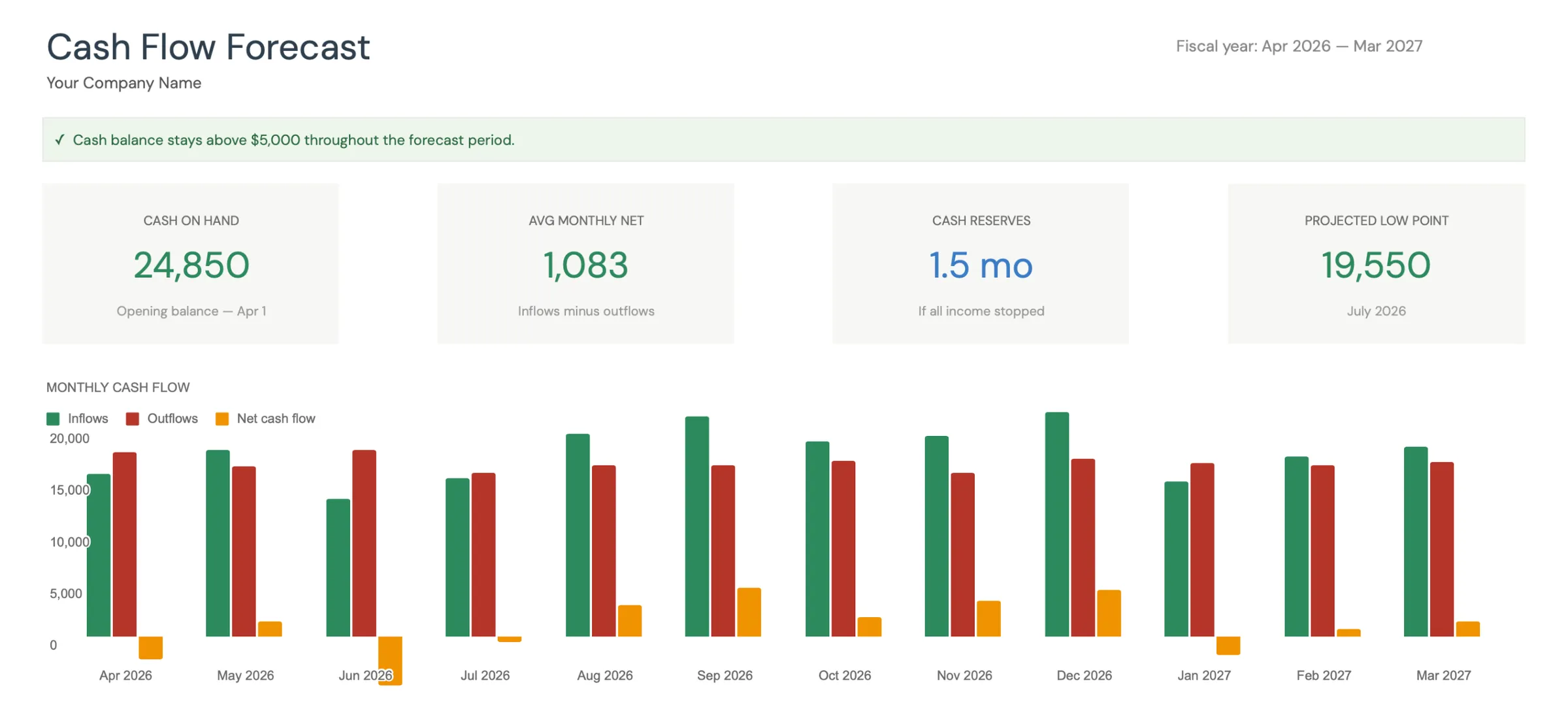
- Visual cash flow dashboard
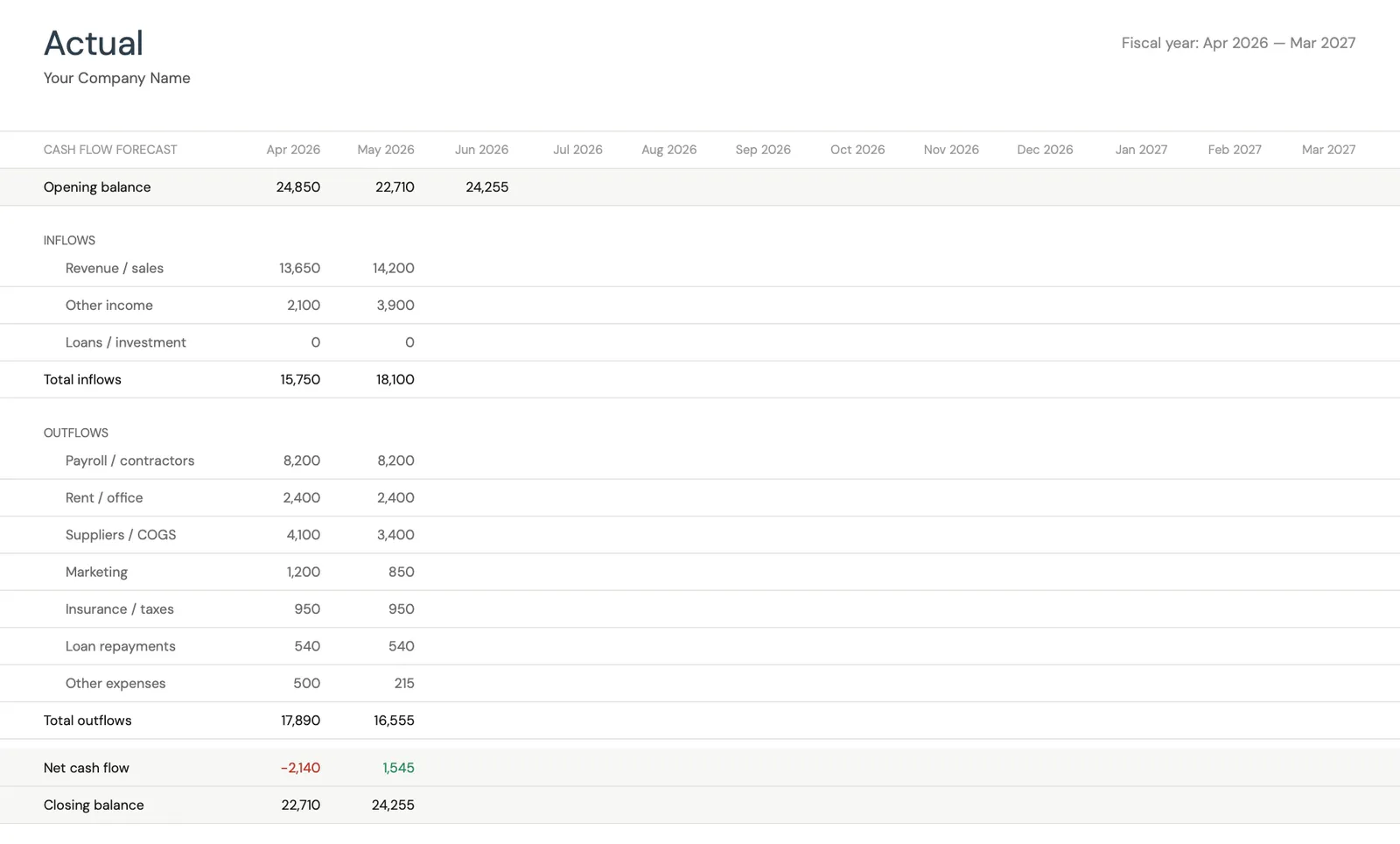
- Forecast vs actuals comparison
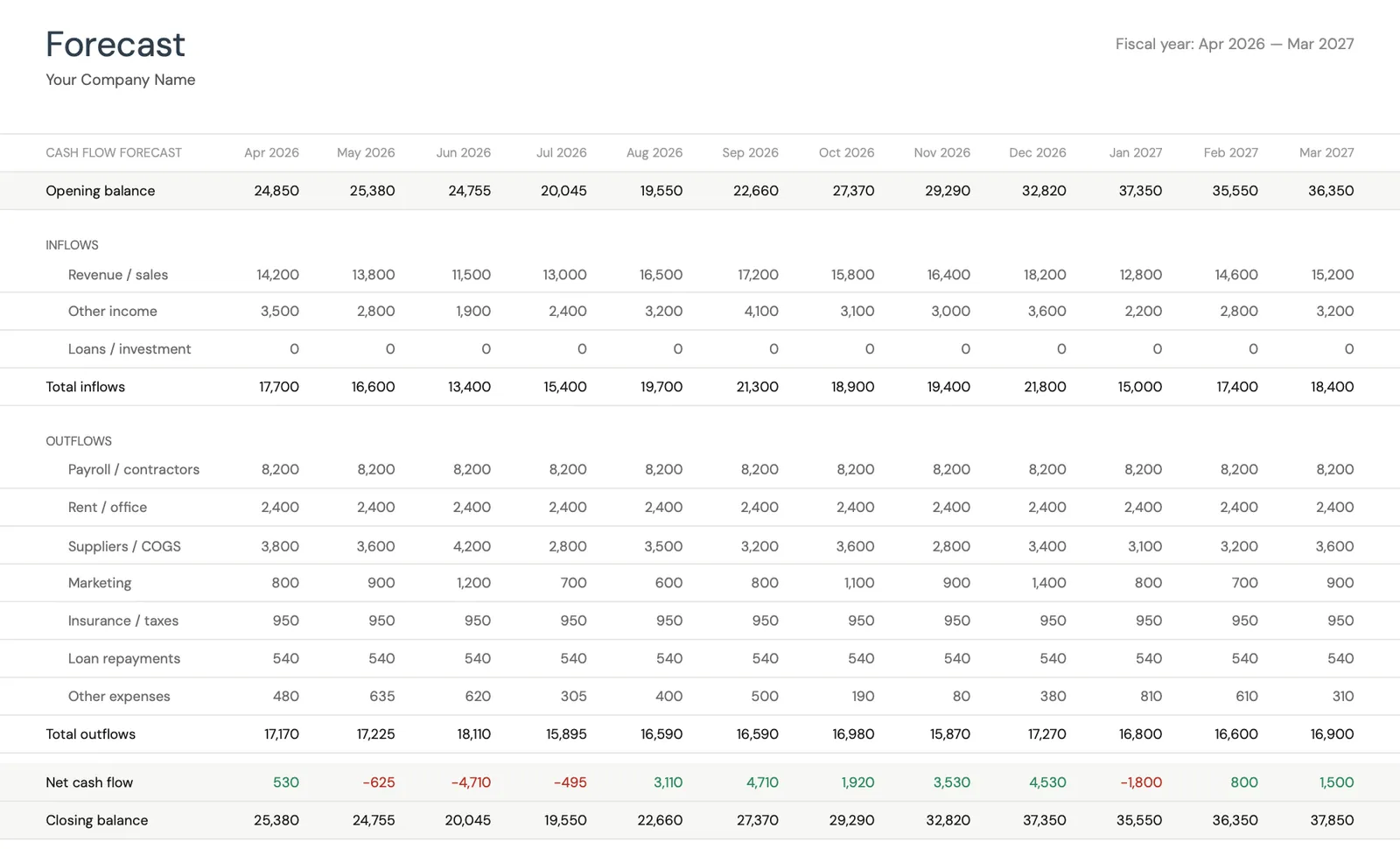
- Scenario planning tools
- Customizable categories
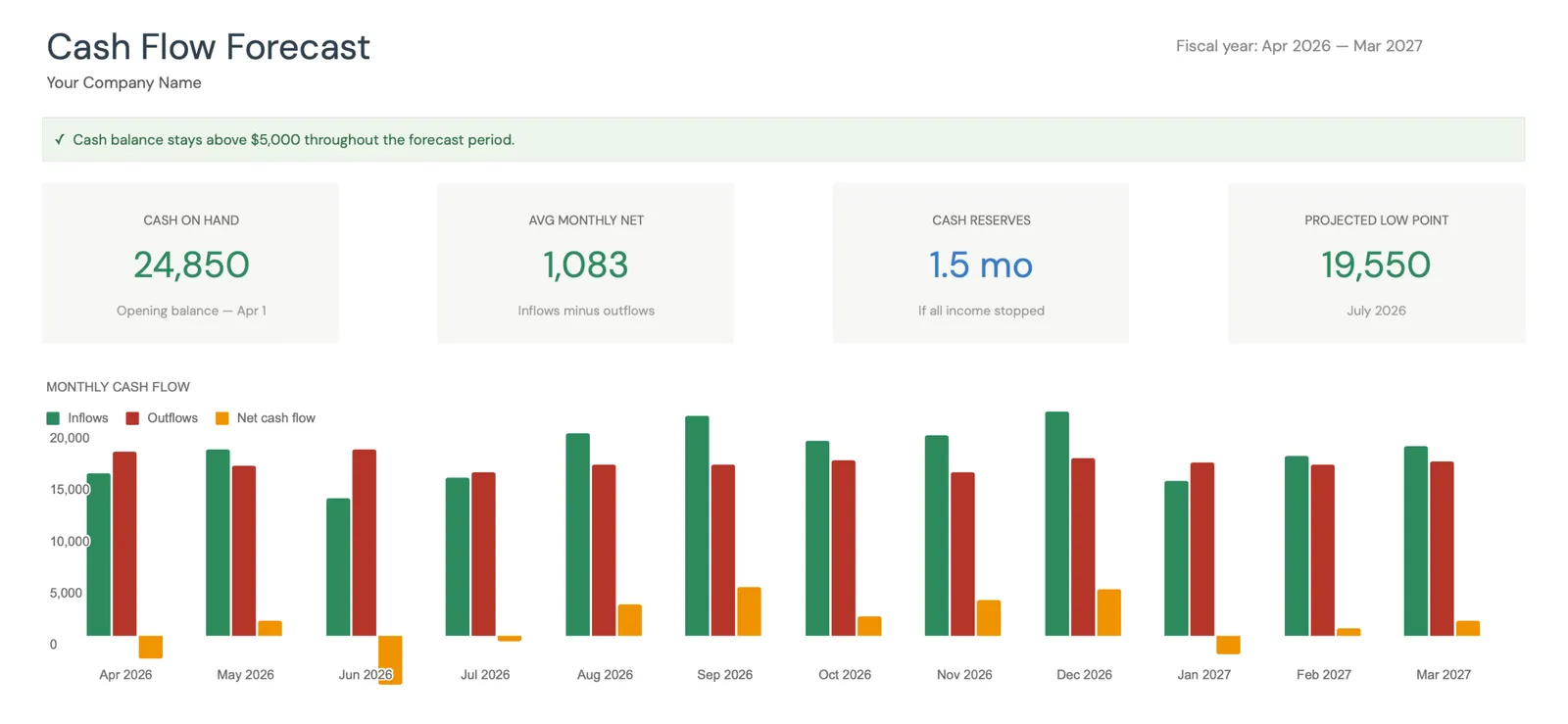
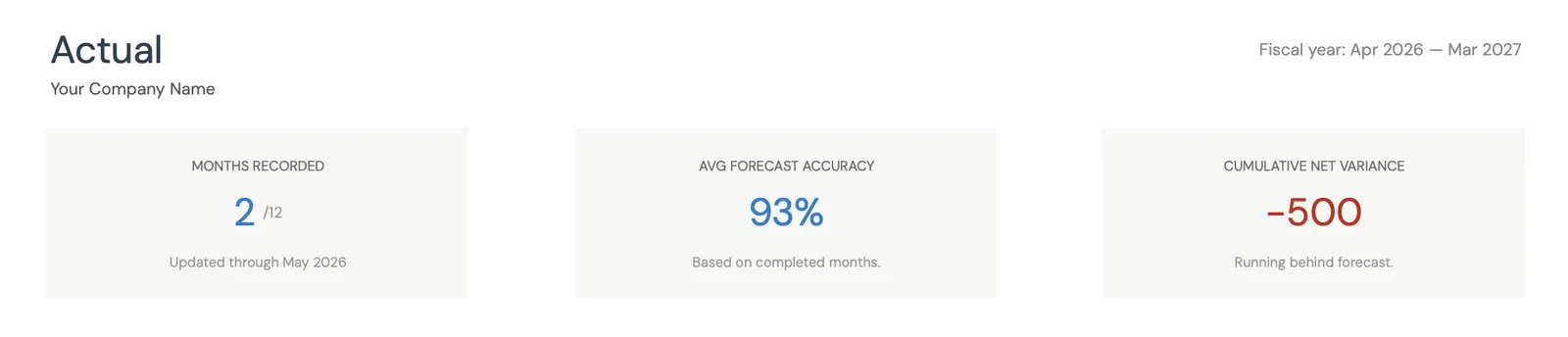
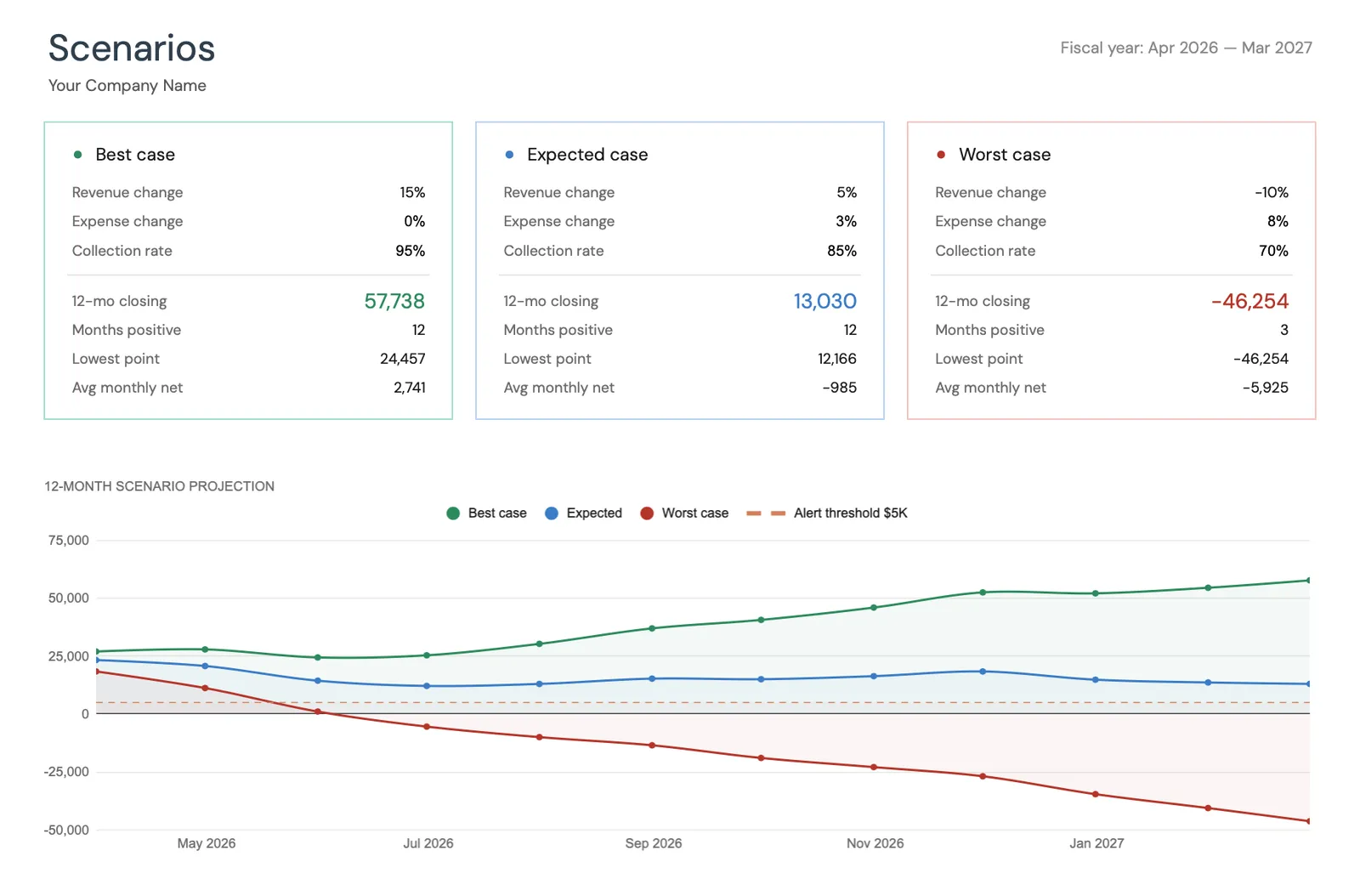
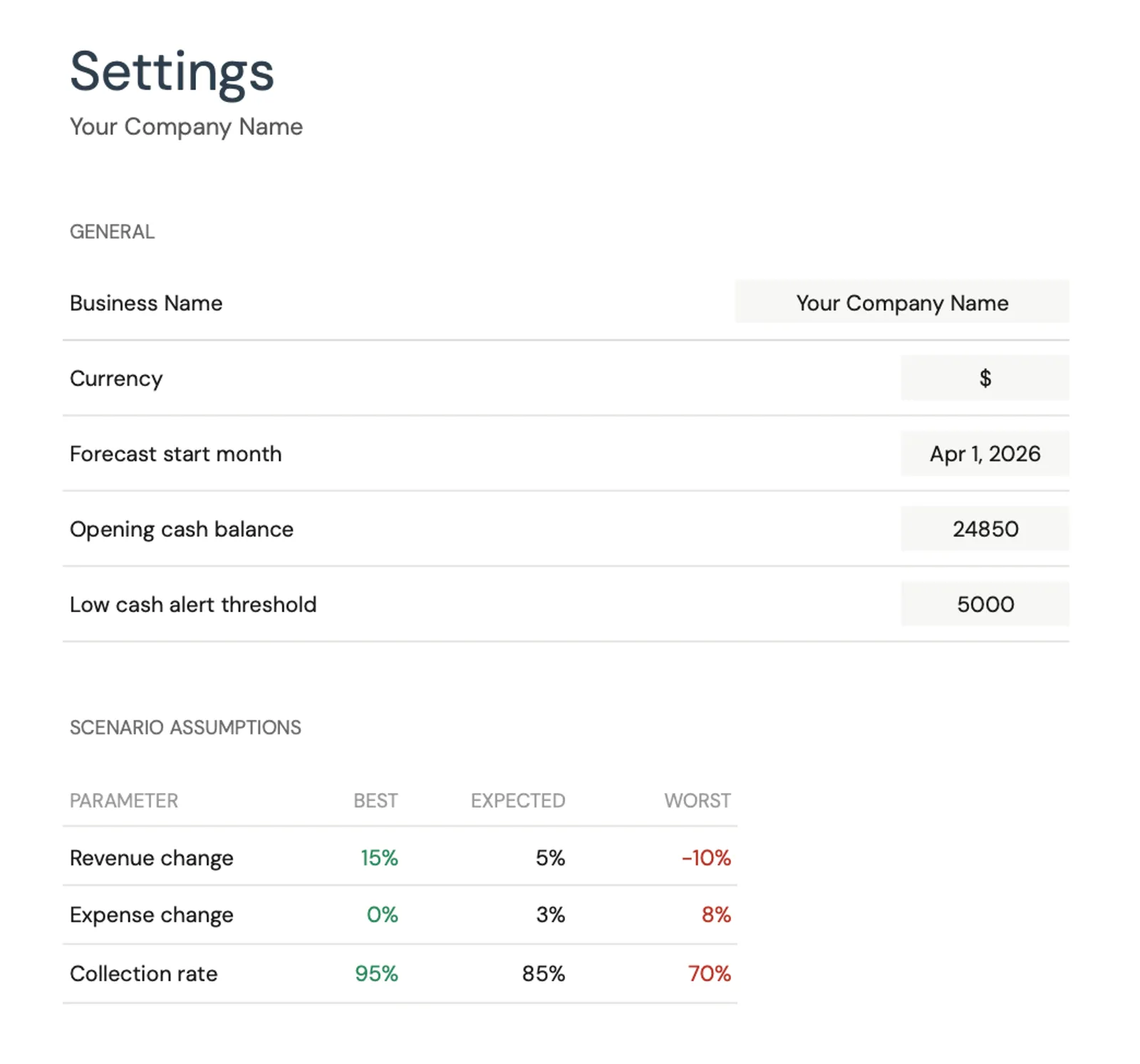
Monthly cash flow overview with KPIs and charts
Track actual cash flow against your forecast
Project cash flow 12 months ahead
Key performance indicators for your cash flow
Model different scenarios for your business
Customize categories for your business type
What You Get
How This Template Works for Consulting Firms
Project-based revenue tracking
Map each active engagement and its billing schedule into the forecast. See how project start dates, end dates, and billing milestones translate into actual cash inflows month by month.
Utilization visibility
Track billable vs non-billable time to forecast realistic revenue. If your team averages 70% utilization, forecasting at 90% creates a dangerously optimistic cash projection.
Billings vs collections variance tracker
Compare forecasted billings and collections against actuals. Track AR aging to identify clients who consistently pay late and adjust future forecasts accordingly.
12-month engagement pipeline outlook
See your projected cash position based on known engagements and pipeline. Identify months where project endings create revenue gaps that need to be filled through business development - ideally months before the gap arrives.
Common Questions
Cash Flow for Consulting Firms - FAQ
What profit margin is typical for consulting firms?
Net margins for consulting firms typically range from 10-25%, with 15-20% being common for well-managed mid-size firms. Solo consultants and small firms can achieve higher margins (25-40%) due to lower overhead. The key metric is revenue per consultant minus their fully loaded cost (salary + benefits + allocated overhead). Margins above 30% often indicate underinvestment in growth.
How do I handle unpredictable project timelines?
Build conservatism into your forecast. If a project is expected to start in March, consider a scenario where it starts in April. Weight pipeline revenue by probability of closing and probability of on-time start. Having a conservative and an optimistic scenario helps you plan for both cases.
What utilization rate should I forecast?
Most consulting firms target 65-80% billable utilization. New firms or those in growth mode may see 50-60% as they build their client base. Forecasting at 100% utilization is unrealistic - account for vacation, sick time, business development, training, and the inevitable gaps between projects.
How do I manage the gap between billing and collection?
Track your average days sales outstanding (DSO) by client. If your average DSO is 52 days, forecast cash arrival 52 days after billing. Some firms offer early payment discounts (2% net-10) to accelerate collection. The forecast should reflect your actual collection patterns, not your contractual payment terms.
Can this template handle both project and retainer work?
Yes. Set up separate revenue categories for project-based and retainer work. Retainer revenue is more predictable and can be forecast with higher confidence. Project revenue should be mapped to specific billing milestones. The combined view shows how retainer income provides a cash floor while project work drives growth.
Can't find the answer you're looking for? Contact our team
Forecast cash flow for your consulting firm
One-time purchase. No subscription. Your financial data stays in your Google Drive.