Cash Flow Forecast
Cash Flow Forecast Template for Construction Companies
Forecast project-based revenue, track material and labor costs, manage subcontractor payments, and plan around retainage schedules - all in a Google Sheets template built for cash flow management.
In Depth
How Construction Companies Handle Money
Construction cash flow has a shape unlike most industries. Money moves in large, infrequent chunks rather than steady daily streams. A general contractor might go three weeks with minimal incoming payments while writing checks to subcontractors, material suppliers, and equipment rental companies every few days. Then a single draw payment arrives and temporarily fills the gap - before the cycle starts again on the next project phase.
Retainage is one of those industry-specific concepts that catches newer contractors off guard. Having 5-10% of every earned payment held back until project completion means a profitable company can still be cash-poor. On a portfolio of active projects totaling $2 million in contract value, retainage alone can lock up $100,000-$200,000. Some contractors treat retainage as a separate line item in their planning, almost like a forced savings account that releases unpredictably.
The interplay between multiple active projects is where construction cash flow gets genuinely complex. One project nearing completion might be releasing retainage while another in the early phases demands heavy material purchases. A third project might be paused due to permitting delays, freezing a draw that was expected this month. Each project has its own cash flow curve, and the company-level picture is the sum of all those curves layered together.
Seasonal patterns also shape the financial year for construction. In colder climates, exterior work compresses into warmer months, creating a revenue peak from May through October and a potential drought in winter. Some firms pursue interior work or maintenance contracts to fill the gap. Others accept the seasonal cycle and build reserves accordingly. Either approach benefits from seeing the full annual pattern mapped out clearly.
The Challenge
Cash Flow Challenges for Construction Companies
Construction businesses face some of the most complex cash flow dynamics of any industry. Revenue arrives in lumpy, milestone-based payments while costs accumulate daily. The gap between spending money and collecting it can stretch for months.
Revenue is project-based and lumpy
Unlike businesses with steady daily sales, construction revenue arrives in large chunks tied to project milestones or draw schedules. A $500,000 project might pay out in 5-7 draws over 6 months. If an inspection delays a milestone by two weeks, that draw slides too - but your labor and material costs keep accumulating. Multiple projects at different stages can create feast-or-famine cash patterns that monthly P&L statements completely obscure.
Retainage holds back 5-10% of every payment
Most commercial contracts withhold 5-10% of each progress payment until project completion. On a $1 million project, that is $50,000-$100,000 you have earned but cannot access for months. Across multiple projects, retainage can tie up six figures of working capital. Forecasting needs to account for both the holdback and the eventual release - which often comes 30-60 days after final completion and punch list sign-off.
Material costs fluctuate and require upfront payment
Lumber, steel, concrete, and other materials can swing 10-20% in price over a few months. Suppliers often require payment within 30 days or even COD for newer accounts, while your client might not pay for that phase of work for 45-60 days. This timing gap means construction companies essentially finance their clients' projects. Material cost as a percentage of revenue typically runs 30-50% depending on the trade.
Subcontractor coordination creates payment cascading
General contractors often rely on subcontractors for 50-70% of project work. Subs expect payment within 30 days of invoicing, but the GC might not receive the corresponding draw for 45-60 days. Pay-when-paid clauses help but do not eliminate the timing mismatch. Late payments to subs damage relationships and can trigger mechanics liens - so the pressure to pay on time is real even when cash is tight.
Start forecasting your cash flow
Forecasting Guide
How to Forecast Cash Flow for Your Construction Company
Construction cash flow forecasting requires a project-by-project approach layered into a company-wide view. Here is how to structure it using the Cash Flow Forecast template.
Revenue Categories
- Progress billing draws (by project)
- Retainage releases
- Change order revenue
- Service and maintenance contracts
- T&M (time and materials) work
Expense Categories
- Materials and supplies (by project)
- Direct labor (field crews)
- Subcontractor payments
- Equipment rental and leases
- Vehicle costs (fuel, maintenance, insurance)
- Payroll taxes and workers' compensation
- General liability and builder's risk insurance
- Bonding costs
- Permits and inspection fees
- Office overhead (rent, admin staff, utilities)
- Loan payments (equipment, line of credit)
Cash Flow Timing
Construction cash flow depends heavily on draw schedules and payment terms. Map each active project's expected draw dates and amounts, then overlay your payment obligations. Most construction companies experience a 30-60 day lag between incurring costs and receiving payment. A line of credit can bridge gaps, but the forecast reveals when and how much you will need to draw - and when you can pay it back.
See It In Action
What the template looks like
Browse through the template to see dashboards, forecasting, actuals tracking, and scenario planning.
- Visual cash flow dashboard
- Forecast vs actuals comparison
- Scenario planning tools
- Customizable categories
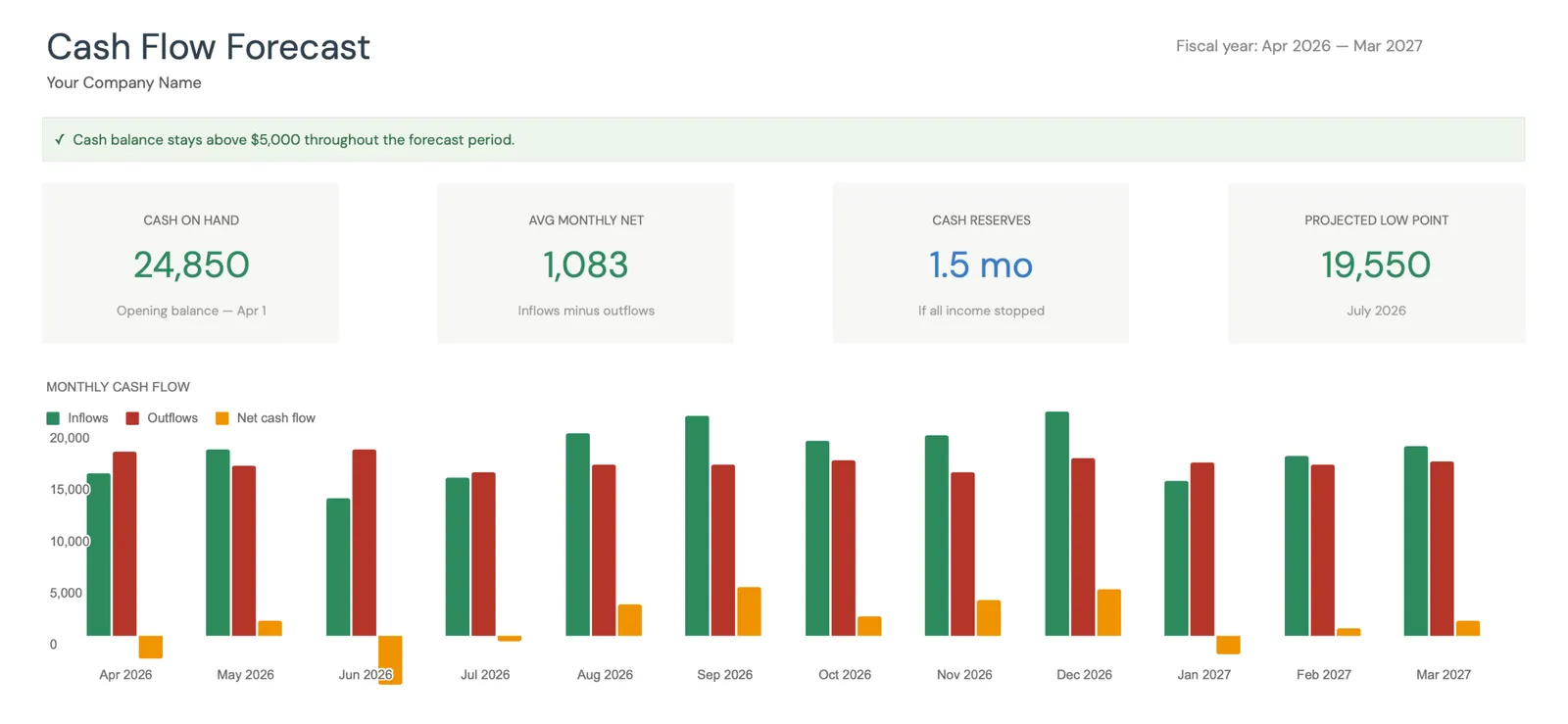
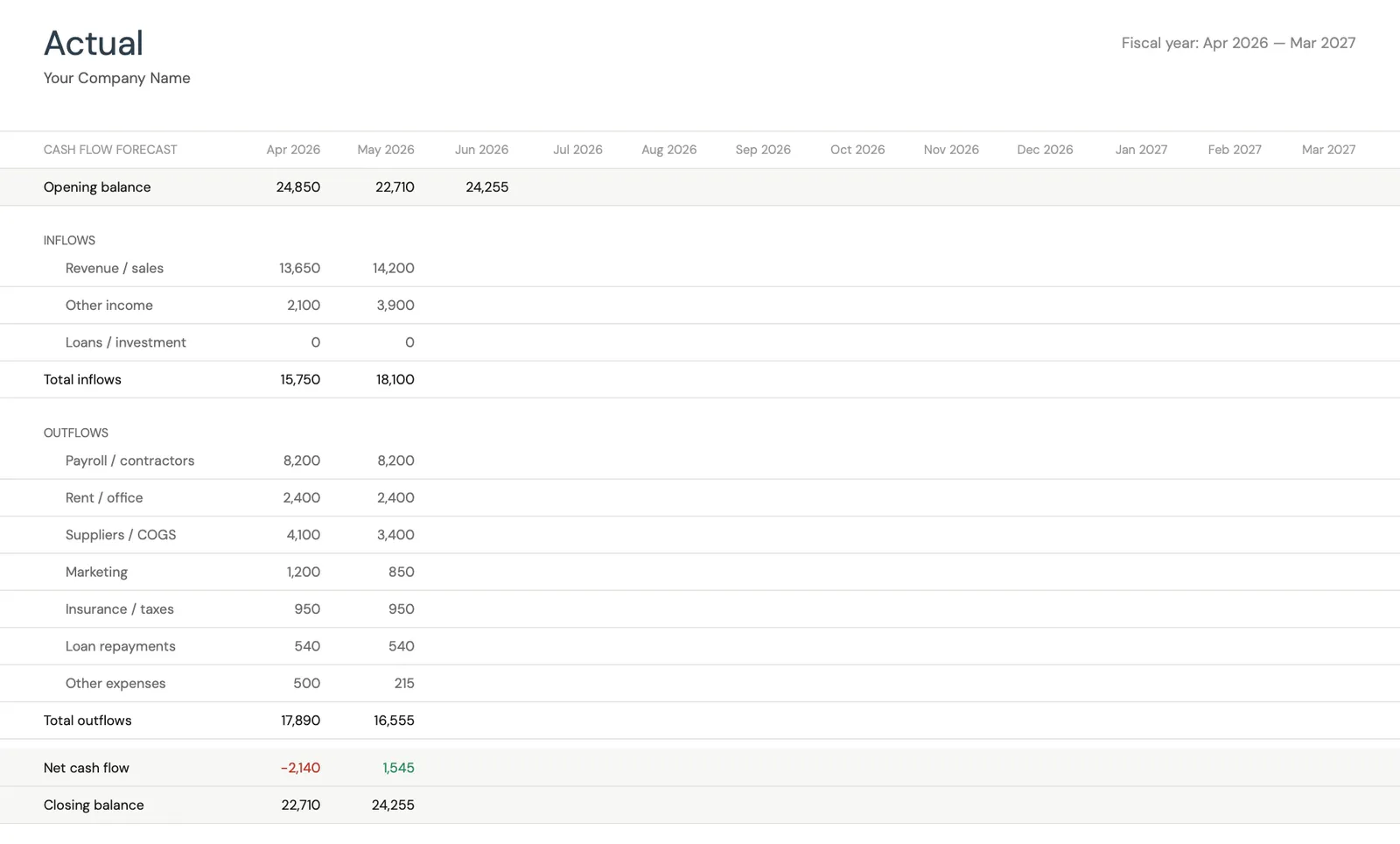
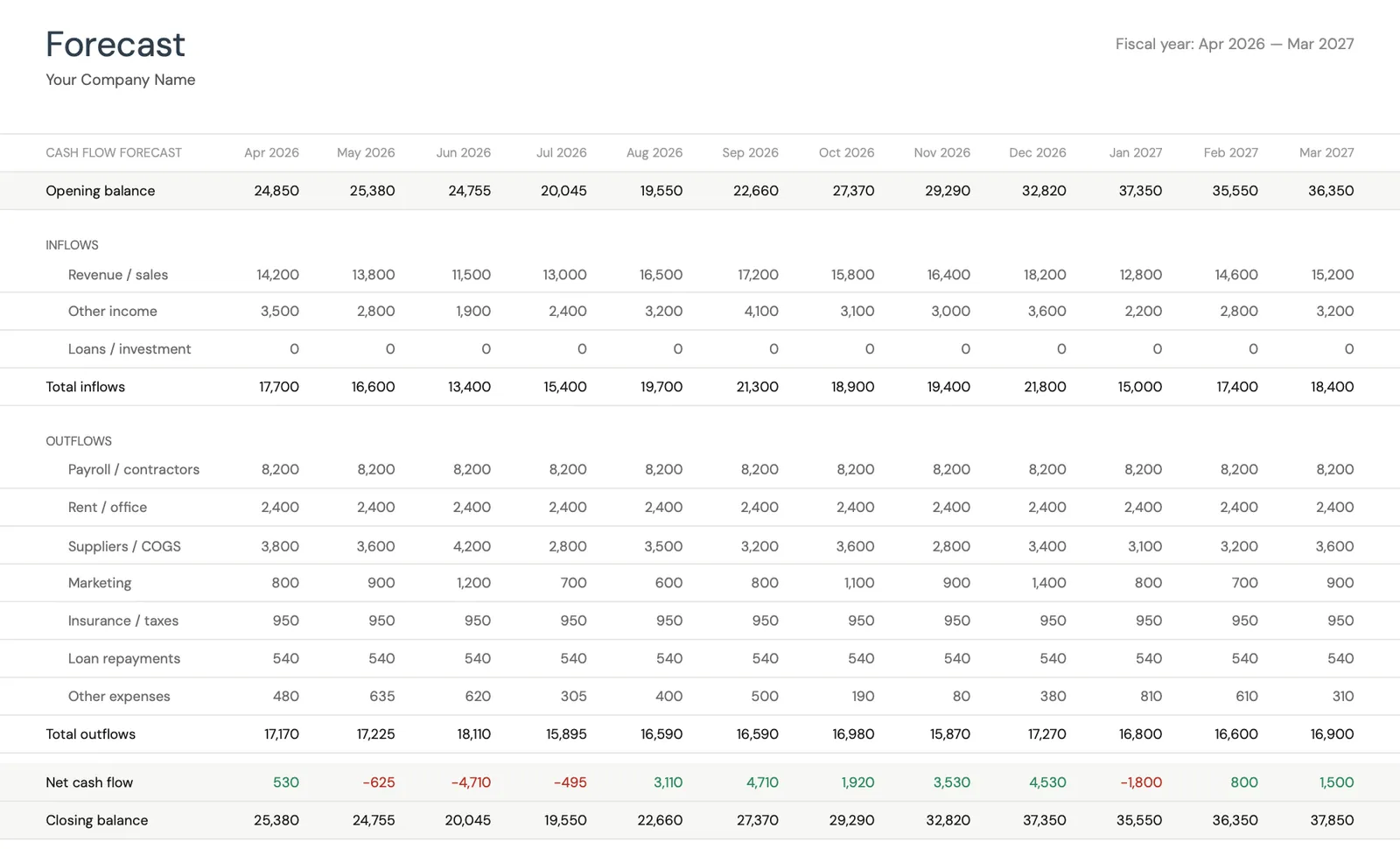
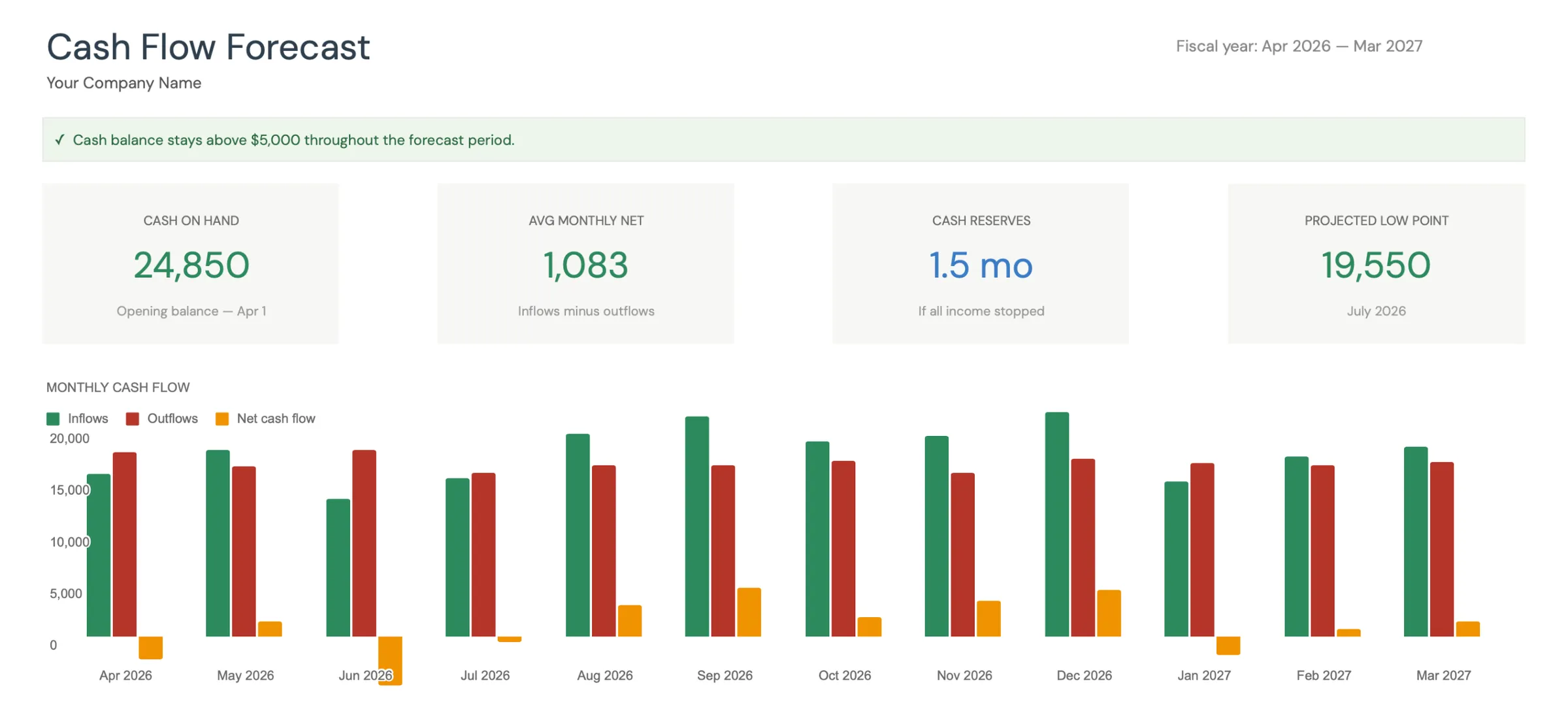
Monthly cash flow overview with KPIs and charts
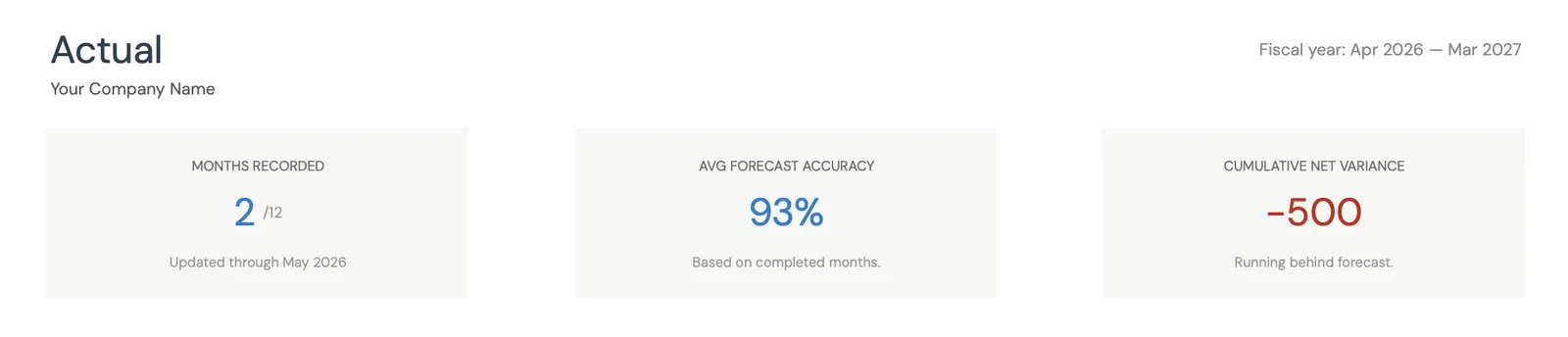
Track actual cash flow against your forecast
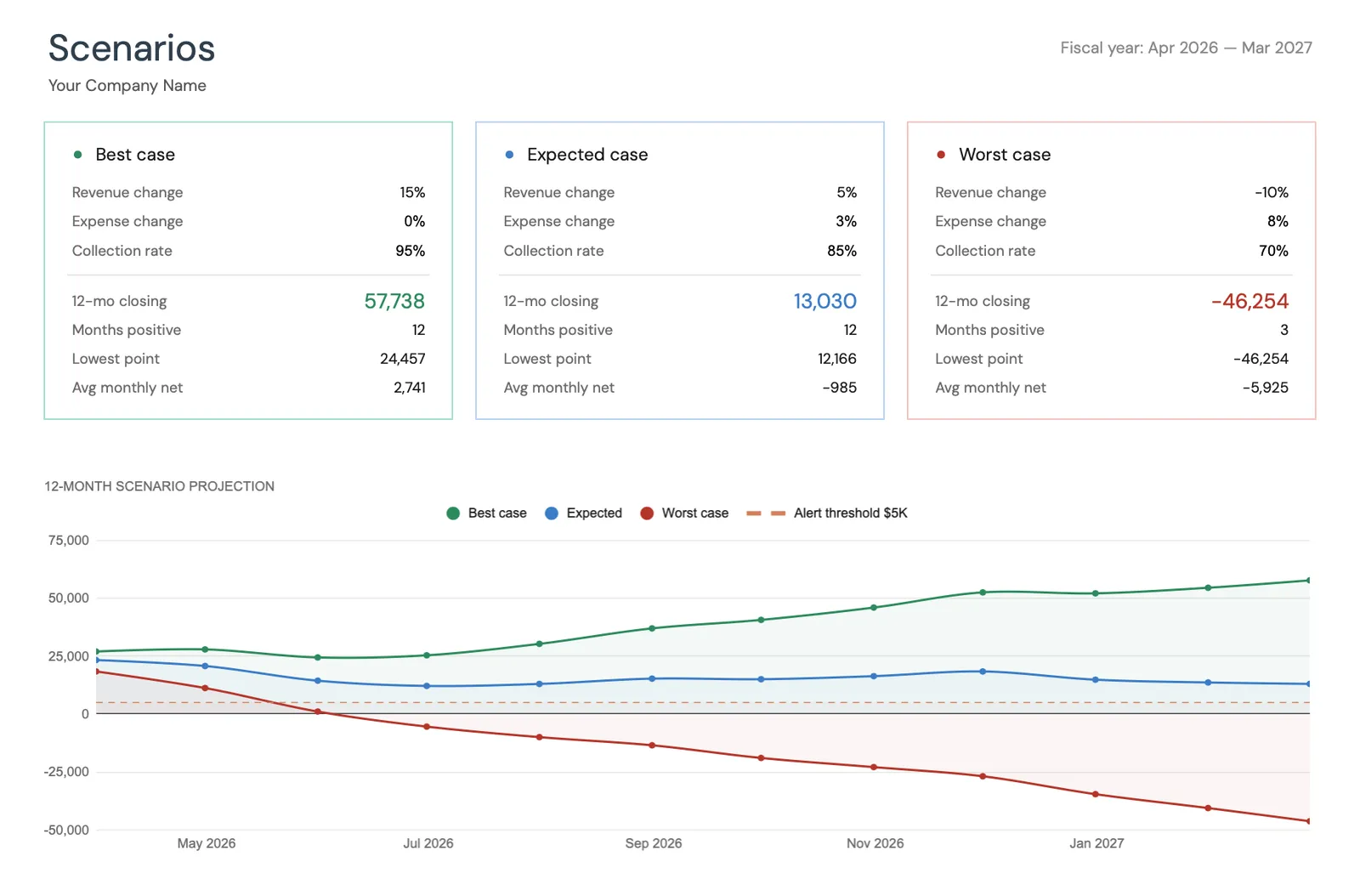
Project cash flow 12 months ahead
Key performance indicators for your cash flow
Model different scenarios for your business
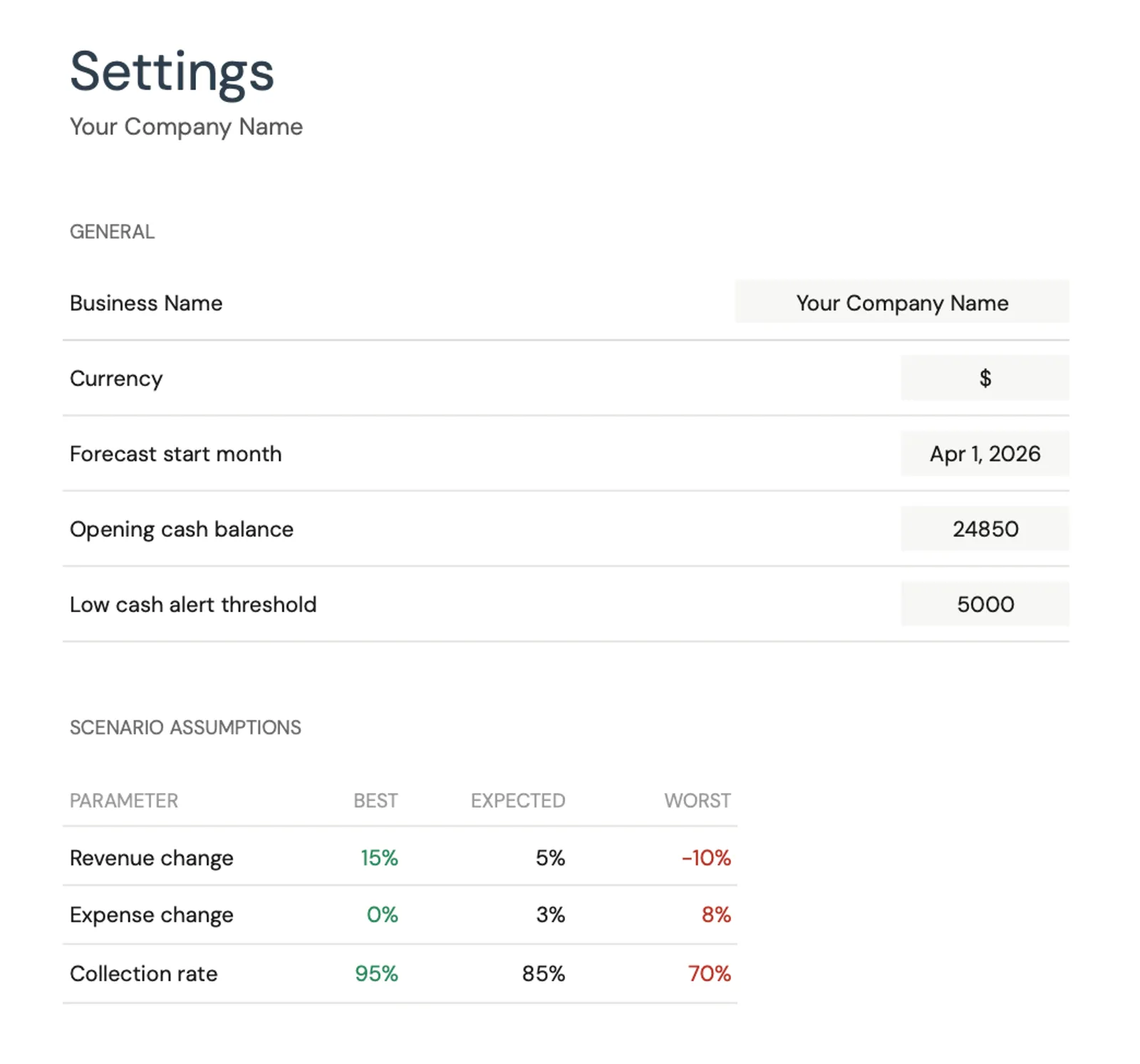
Customize categories for your business type
What You Get
How This Template Handles Construction Finances
Project-based revenue tracking
Map each project's draw schedule into the monthly forecast. See when milestone payments are expected and track actual collection dates against projections. This is where construction cash flow forecasting lives or dies.
Retainage tracking
Track retainage held on each project and forecast when it will be released. This is money you have earned but cannot spend - knowing the total retainage outstanding and expected release dates is critical for planning.
Forecasted draws vs actual collections
Compare forecasted draws against actual collections each month. Construction projects almost always deviate from the original schedule, so regular updates keep the forecast useful rather than fictional.
Year-ahead project pipeline cash view
See your projected cash position across the full project pipeline. Identify months where multiple projects will require heavy material purchases or where draw schedules create cash surpluses worth earmarking for slower periods.
Common Questions
Cash Flow for Construction Companies - FAQ
What profit margin is typical for construction companies?
Net profit margins in construction typically range from 2-8% for general contractors and 8-15% for specialty trades. These figures vary widely by project type, region, and market conditions. The key distinction in construction is that profit on paper does not mean cash in the bank - retainage and payment timing mean profitable companies can still face cash crunches.
How do I handle projects that span multiple months?
Break each project into its expected draw schedule and enter each draw as revenue in the month you expect to collect it - not when you invoice. On the expense side, map material purchases and sub payments to the months they will actually be paid. The template's monthly view then shows the net cash impact of all active projects combined.
How do I account for retainage in my forecast?
Track retainage as a separate revenue category. When you forecast a $100,000 draw with 10% retainage, enter $90,000 as current revenue and note $10,000 in retainage. When the project completes, forecast the retainage release in the expected collection month - typically 30-60 days after final acceptance.
What is the biggest cash flow mistake construction companies make?
Taking on new projects without enough working capital to fund the startup costs before the first draw arrives. A new project might require $50,000-$100,000 in labor and materials before the first progress payment. The forecast helps identify whether you have the cash to start new work or need to sequence project starts carefully.
Can this template handle multiple active projects?
Yes. Set up revenue categories for each active project (or group smaller projects). The template then shows how all projects combine to create your overall cash position. This company-wide view is essential because a cash surplus from one project often funds the startup costs of another.
Can't find the answer you're looking for? Contact our team
Forecast cash flow for your construction companie
One-time purchase. No subscription. Your financial data stays in your Google Drive.