Cash Flow Forecast
Cash Flow Forecast Template for Cleaning Businesses
Forecast recurring cleaning revenue, manage employee wages and supply costs, plan for client acquisition, and track growth spending - all in a Google Sheets template built for cash flow management.
In Depth
Building Steady Cash Flow in a Cleaning Business
Cleaning businesses have a financial advantage that many service businesses lack - high recurring revenue. A residential cleaning client who books biweekly service at $150 per visit represents $3,900 in annualized revenue that arrives on a predictable schedule. Multiply that by 40 or 50 regular clients and the baseline revenue picture becomes quite stable. The challenge is that this stability masks the constant churn underneath - losing two or three clients per month is normal, and each loss creates a gap that takes time and marketing dollars to fill.
The transition from residential to commercial cleaning changes the financial character of the business in meaningful ways. Commercial contracts are larger - $2,000 to $10,000 per month - but they come with payment terms that residential clients never impose. A commercial client paying on net-30 or net-45 means the cleaning company is essentially financing a month or more of service before receiving payment. Growing the commercial side of the business often requires building working capital reserves that were unnecessary when residential clients paid at time of service.
Labor is the dominant expense and the primary scaling constraint. Every new cleaning team member represents both capacity and cost. A new hire might cost $600-$800 per week in wages and payroll taxes while needing two to four weeks to build a full schedule of client assignments. That ramp-up period is a cash investment in future revenue. Companies that grow too quickly sometimes find themselves with more staff than client demand supports, creating a temporary but real cash drain.
Supply costs in cleaning are relatively small as a percentage of revenue - typically 3-8% - but they represent an area where bulk purchasing decisions directly affect cash flow. Buying a six-month supply of cleaning products might save 15-20% per unit, but it ties up $2,000-$5,000 in inventory sitting in a storage closet. Some operators find that monthly purchasing at slightly higher unit costs preserves cash flexibility in a way that outweighs the per-unit savings.
The Challenge
Cash Flow Challenges for Cleaning Businesses
Cleaning businesses benefit from recurring revenue but face tight margins, employee management challenges, and the constant need for client replacement. Cash flow management determines whether growth is sustainable or chaotic.
Recurring revenue is valuable but fragile
A cleaning business with 50 regular residential clients at $150/visit generating biweekly service has $150,000 in annualized recurring revenue. But client churn of 2-3% per month means losing 1-2 clients every month. Each lost client requires marketing spend and time to replace. The gap between losing a client and replacing them creates revenue dips that compound if replacement slows down. Monitoring net client count monthly is essential.
Labor costs consume 40-55% of revenue
Cleaning is labor-intensive, and employee wages (plus payroll taxes, insurance, and supplies) typically represent 40-55% of revenue. The challenge: you need enough staff to serve your clients, but you pay staff whether they have a full schedule or not. A new employee might cost $600/week in wages but generate only $400/week in revenue until their schedule fills. This scaling gap means growth phases temporarily reduce cash flow.
Client payment timing varies widely
Residential clients often pay at time of service or within days. Commercial cleaning contracts might pay net-30 or net-45. A cleaning business serving both markets has two very different cash flow patterns. Commercial accounts are typically larger ($2,000-$10,000/month) but slower to pay. A growing commercial client base increases revenue but also increases accounts receivable, tying up more cash.
Growth requires spending money before earning it
To grow, a cleaning business needs to invest in marketing, hire staff before revenue fully materializes, purchase equipment, and potentially add vehicles. These investments all require cash upfront. A company growing from $20,000 to $30,000 in monthly revenue might need $5,000-$10,000 in upfront growth investment - vehicles, marketing, equipment, and payroll for new hires during their ramp-up period.
Start forecasting your cash flow
Forecasting Guide
How to Forecast Cash Flow for Your Cleaning Business
Cleaning business cash flow forecasting centers on recurring client count, average revenue per client, and the cost to serve each account. Here is how to structure it using the Cash Flow Forecast template.
Revenue Categories
- Recurring residential cleaning
- Commercial cleaning contracts
- Deep cleaning and move-in/move-out services
- Window and specialty cleaning
- One-time or occasional clients
Expense Categories
- Employee wages
- Payroll taxes and workers' compensation
- Cleaning supplies and chemicals
- Equipment (vacuums, buffers, carpet cleaners)
- Vehicle costs (fuel, insurance, maintenance)
- Marketing and lead generation
- Insurance (general liability, bonding)
- Scheduling and CRM software
- Uniforms and employee supplies
- Office and administrative costs
- Training and onboarding
Cash Flow Timing
Residential cleaning revenue is typically collected within a week of service, making cash flow fairly predictable. Commercial accounts pay on terms (net-15 to net-45). The main timing consideration is seasonal: demand for residential cleaning often dips in January and summer vacation months. Deep cleaning peaks in spring and before holidays. Build cash reserves during steady months to cover seasonal dips and fund planned growth investments.
See It In Action
What the template looks like
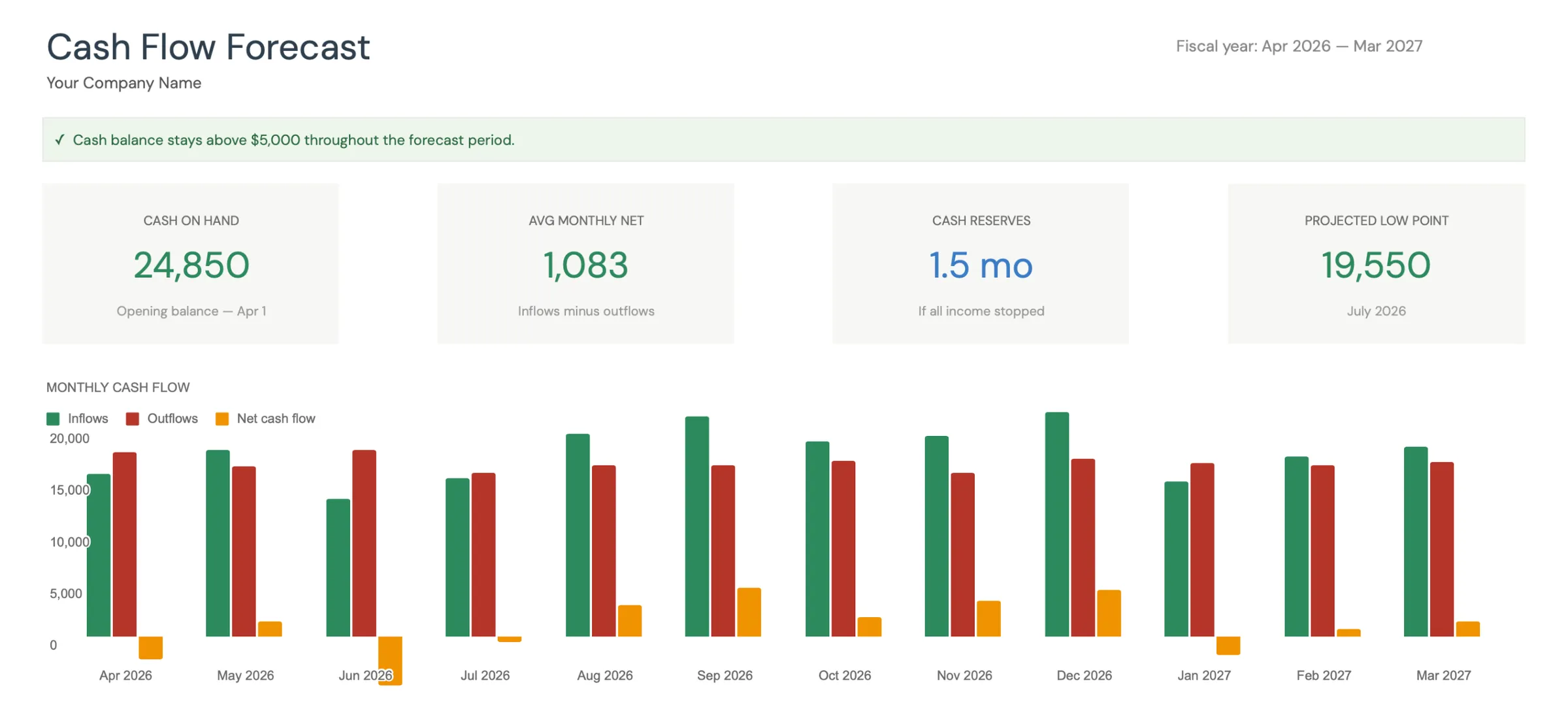
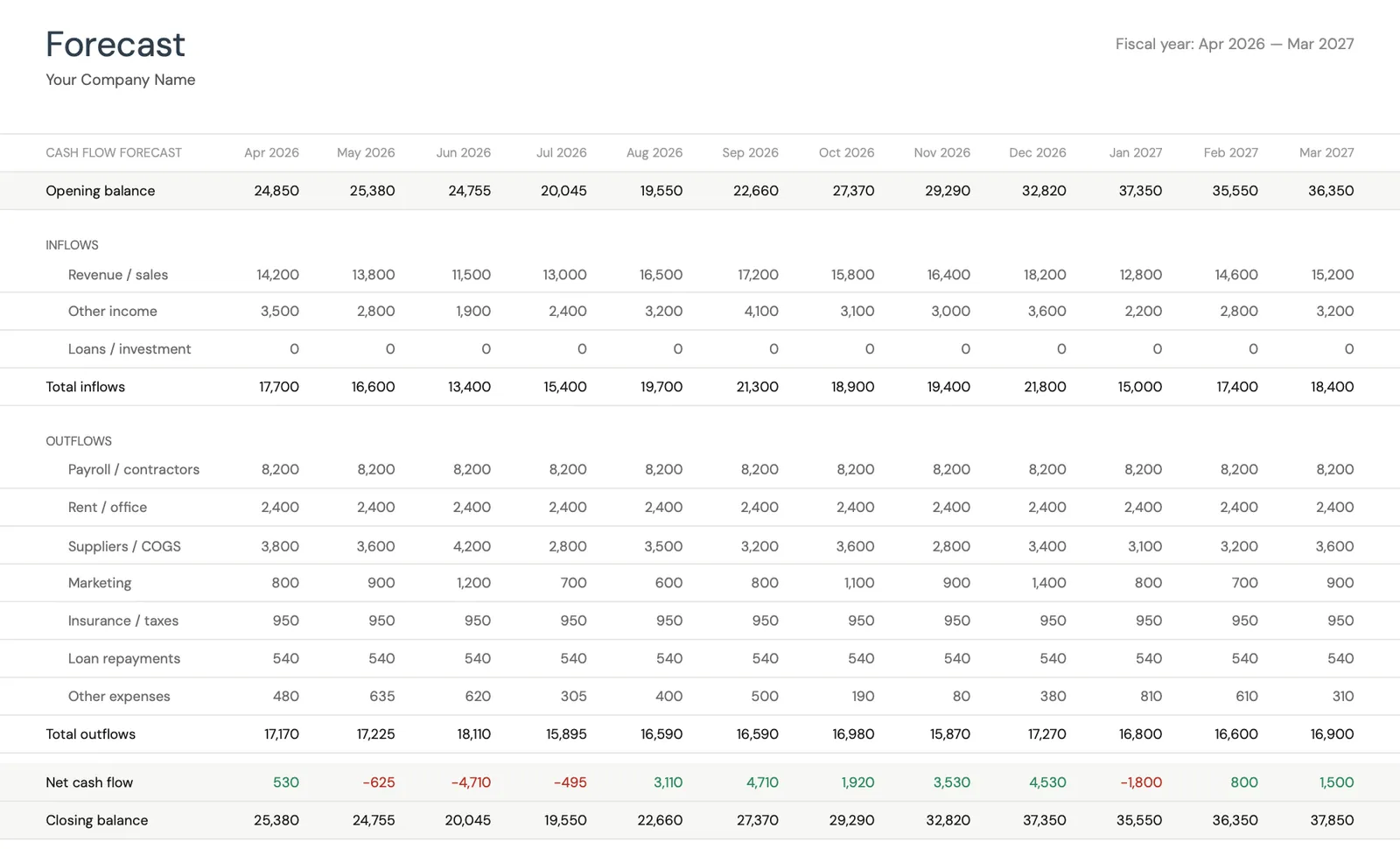
Browse through the template to see dashboards, forecasting, actuals tracking, and scenario planning.
- Visual cash flow dashboard
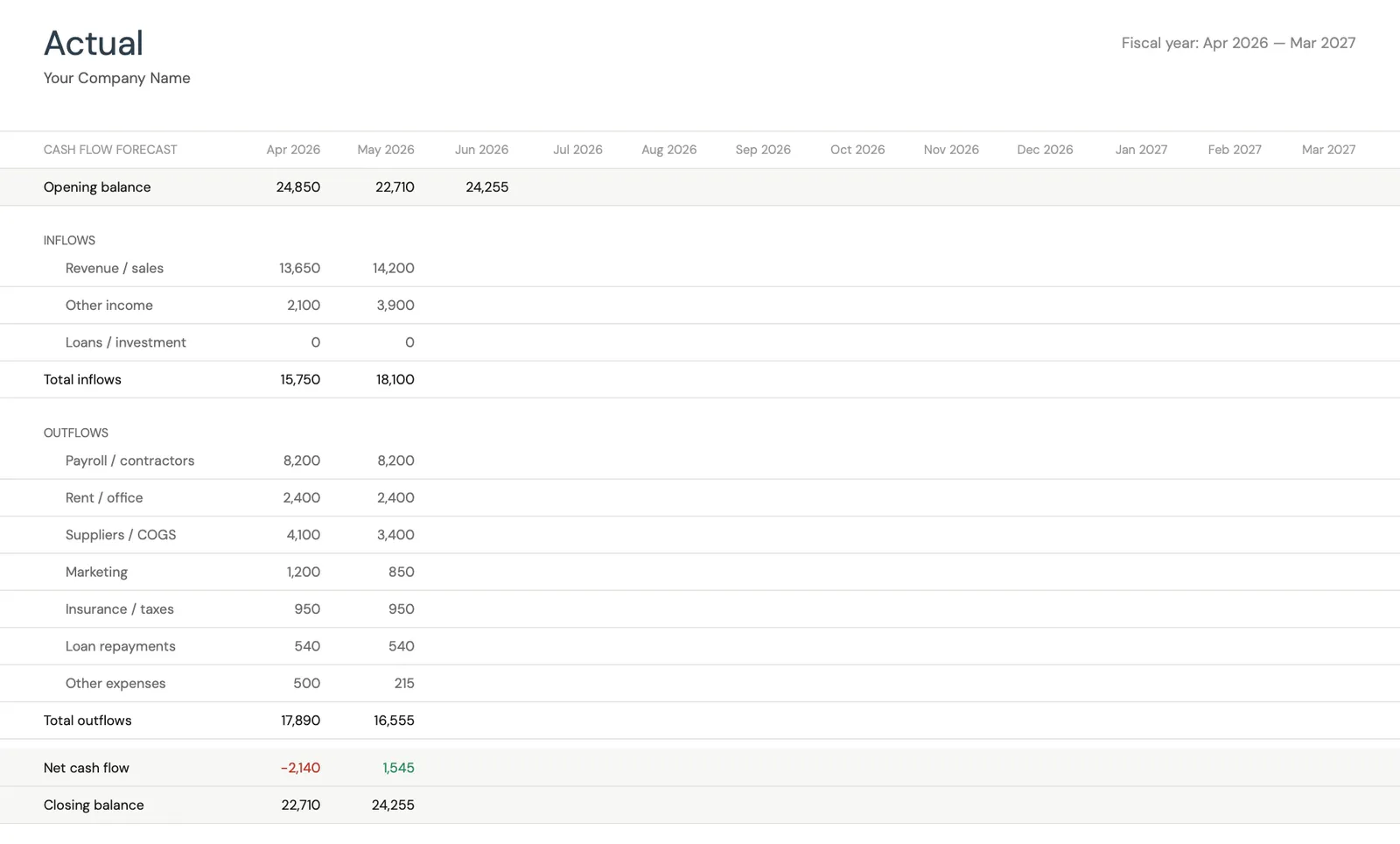
- Forecast vs actuals comparison
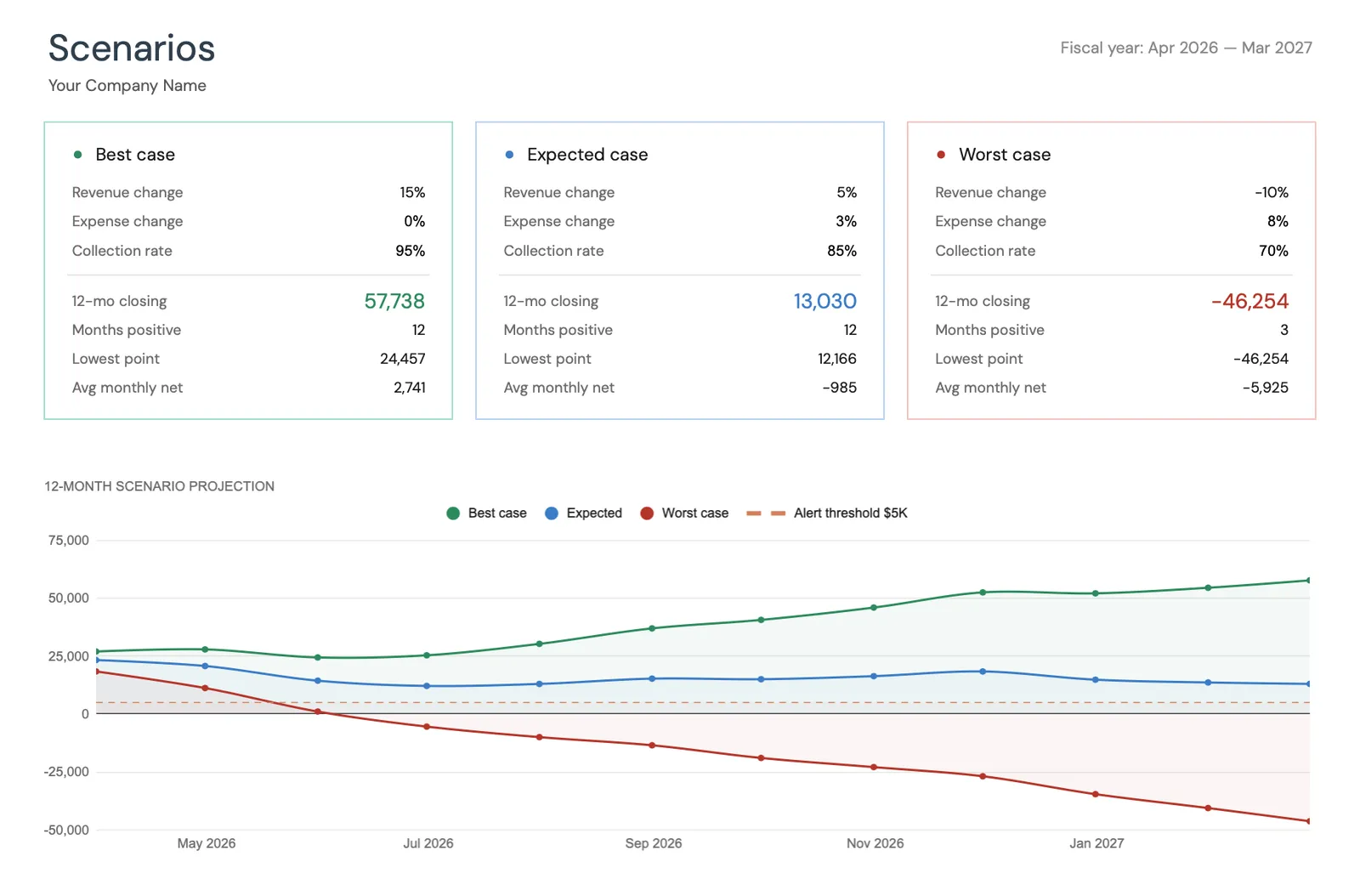
- Scenario planning tools
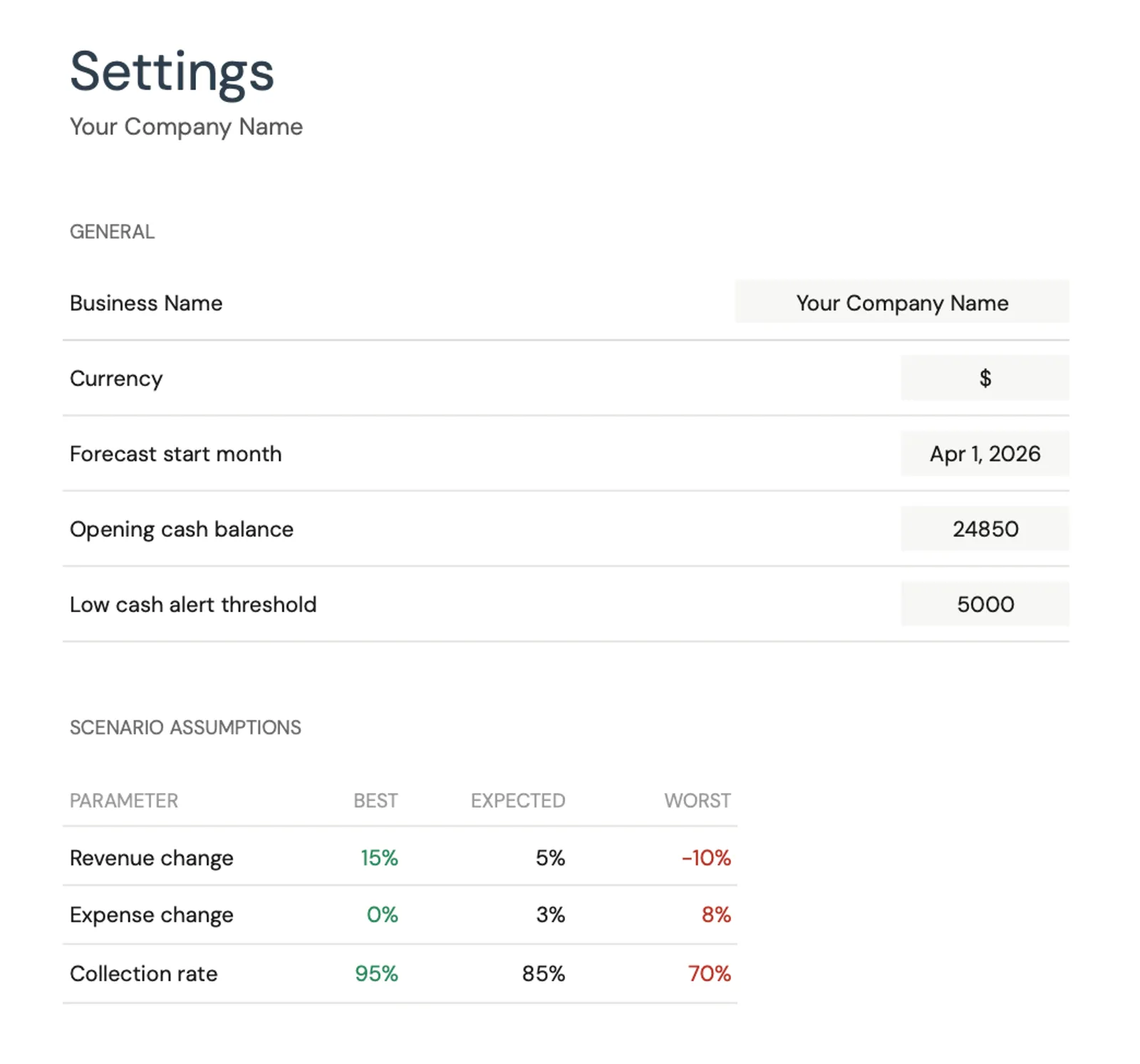
- Customizable categories
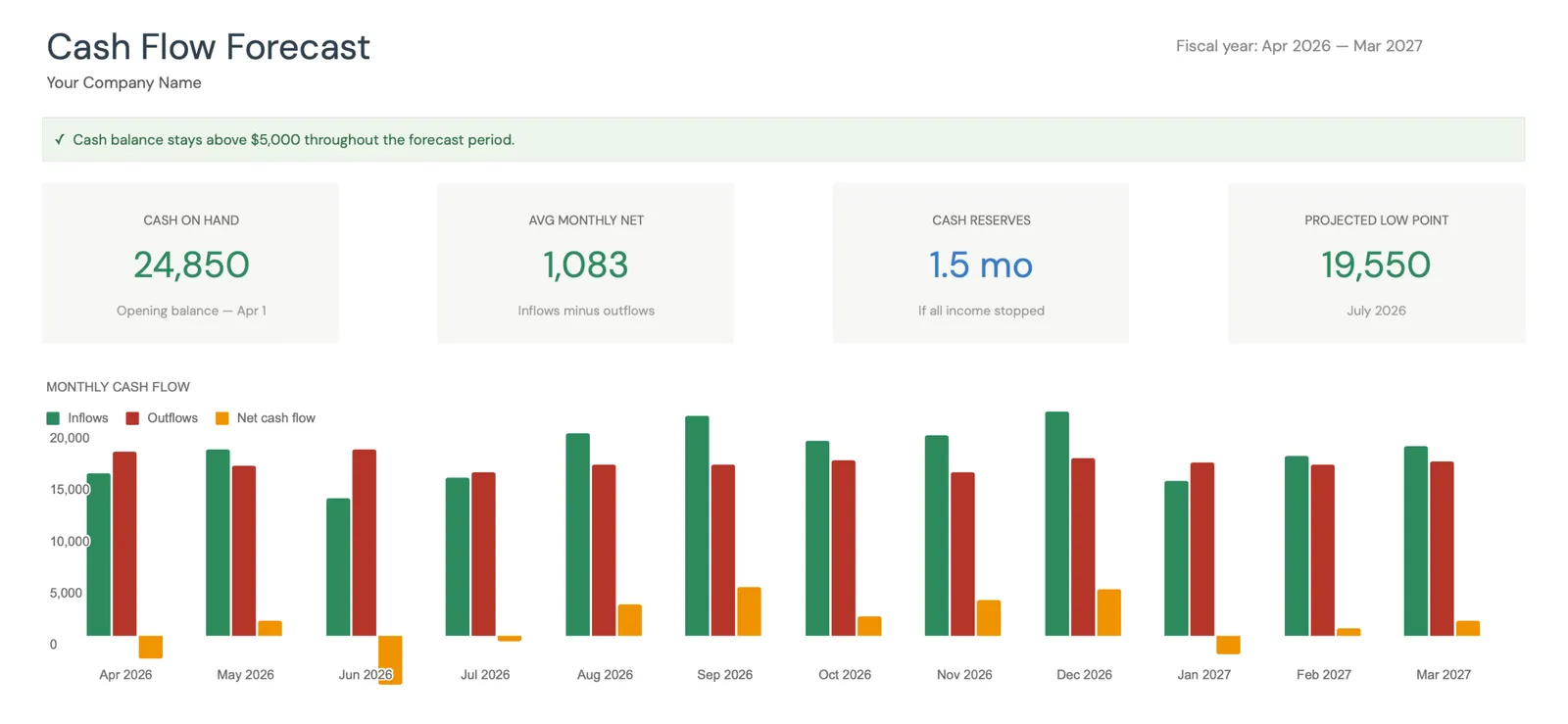
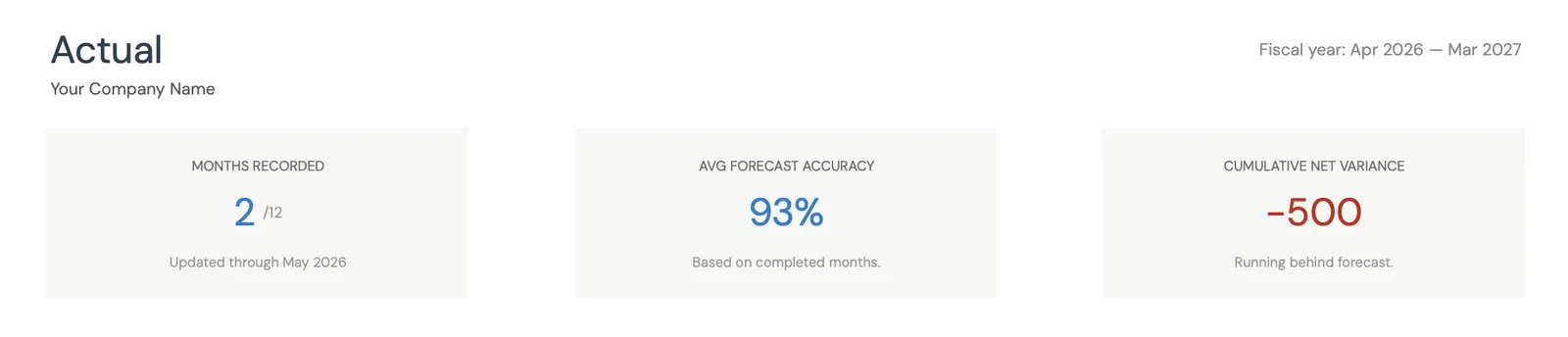
Monthly cash flow overview with KPIs and charts
Track actual cash flow against your forecast
Project cash flow 12 months ahead
Key performance indicators for your cash flow
Model different scenarios for your business
Customize categories for your business type
What You Get
What Cleaning Businesses Get From This Template
Recurring revenue tracking
Track your base of recurring clients and their monthly revenue contribution. See how client additions and losses affect your revenue trajectory month over month. Net client growth is the most important metric for cleaning businesses.
Labor cost management
Track labor as a percentage of revenue to ensure margins stay healthy as you grow. If labor costs creep above 50% of revenue, the forecast reveals the trend before it becomes a crisis.
Client count and revenue vs your plan
Compare projected client count, revenue, and costs against actuals. Cleaning businesses with good data can forecast within 5-10% accuracy, making the variance analysis especially useful for catching problems early.
Year-ahead growth and cash projection
Plan growth investments, vehicle purchases, and hiring against your projected cash position. See how seasonal demand patterns affect your ability to fund growth initiatives.
Common Questions
Cash Flow for Cleaning Businesses - FAQ
What profit margin is typical for cleaning businesses?
Net margins for cleaning businesses typically range from 10-28%. Solo operators often achieve higher margins (20-35%) since they avoid employee costs, while companies with employees usually see 10-20% net margins. The key metrics are revenue per cleaning hour and labor cost as a percentage of revenue. Commercial cleaning typically has lower margins (8-15%) but higher volume.
How do I forecast client churn?
Track your monthly client retention rate. If you lose 2 out of 50 clients per month, that is 4% monthly churn. At that rate, you need to add 2 new clients per month just to stay flat. The forecast should model both expected client losses and the cost and timeline to replace them. Seasonal patterns matter - more clients cancel in summer and January.
When should I hire additional cleaning staff?
The forecast helps answer this by modeling the revenue gap between current capacity and demand. If your team is at 90% capacity and you are turning away work, the forecast can model the cash flow impact of a new hire - typically 2-4 weeks of wage costs before their schedule generates enough revenue to cover their cost.
How do I handle the transition from residential to commercial clients?
Commercial accounts have different cash flow characteristics: higher revenue but slower payment, longer contracts but longer sales cycles. Model commercial revenue separately with appropriate payment lag (net-30 to net-45). The forecast shows how a growing commercial book affects overall cash flow timing and whether you need working capital to bridge the collection gap.
What about supply costs - how do I budget for those?
Cleaning supplies typically run 3-8% of revenue. Track supply cost per client visit to identify waste or price increases. Buying supplies in bulk reduces per-unit costs but requires more upfront cash. The forecast helps balance bulk purchasing against available cash - buying a 3-month supply saves money but ties up $1,500-$3,000 that is not available for other uses.
Can't find the answer you're looking for? Contact our team
Forecast cash flow for your cleaning businesse
One-time purchase. No subscription. Your financial data stays in your Google Drive.