Cash Flow Forecast
Cash Flow Forecast Template for Accounting / Bookkeeping Firms
Forecast recurring bookkeeping revenue, plan for tax season peaks, manage staff costs, and track client retention - all in a Google Sheets template built for cash flow management.
In Depth
Tax Season, Recurring Revenue, and Accounting Firm Finances
Accounting firms experience a financial pattern that resembles a heartbeat - a sharp spike during tax season followed by a long, relatively flat stretch through the rest of the year. For firms that derive most of their revenue from tax preparation, this creates a concentration of income into January through April that must sustain the business through the remaining eight months. The math is straightforward but demanding - a firm that earns $250,000 during tax season and $200,000 across the other eight months needs to manage the seasonal surplus carefully to avoid mid-year cash problems.
The shift toward recurring monthly revenue - through bookkeeping, payroll services, and advisory retainers - has become a defining trend in the accounting profession partly because of what it does for cash flow. A bookkeeping client paying $800 per month provides $9,600 in predictable annual revenue that arrives in steady installments rather than a seasonal lump. Building a base of recurring clients does not eliminate the tax season peak, but it raises the baseline revenue during slow months and reduces dependence on a few intense weeks of work.
Staff utilization follows the same seasonal curve as revenue, creating a management challenge. During tax season, staff may work 50-60 hour weeks and the firm might bring in seasonal preparers. During summer, the same team may have significant downtime. Some firms use the quiet months for training, system improvements, and proactive client advisory work - activities that do not generate immediate revenue but build capacity for future billing. Others find that summer is when they lose staff to burnout recovery or competitive offers, making retention a year-round financial consideration.
The billing-to-collection cycle in accounting firms often stretches longer than expected, particularly during tax season when the focus is on completing returns rather than chasing outstanding invoices. A firm that bills $80,000 in March might not collect the full amount until May or June, creating a lag between the intense work period and when the resulting cash actually arrives. Some firms address this by collecting deposits at engagement or requiring payment at filing, which significantly improves cash flow timing during the months when it matters most.
The Challenge
Cash Flow Challenges for Accounting and Bookkeeping Firms
Accounting firms experience extreme seasonal revenue patterns driven by tax deadlines, while maintaining staff and infrastructure year-round. The challenge is building a sustainable practice that does not depend entirely on a few months of peak billing.
Tax season creates extreme revenue concentration
For many accounting firms, 40-60% of annual revenue is generated during the January-April tax season. A firm billing $500,000 annually might generate $200,000-$300,000 in those four months and only $200,000-$300,000 across the remaining eight. This creates a cash surplus in spring followed by months of drawing down reserves. The pattern is predictable but the magnitude depends on client mix and service offerings.
Staff costs are year-round while revenue is seasonal
Experienced accountants and bookkeepers command $55,000-$90,000+ in annual salary. During tax season, overtime and temporary staff add 20-40% to labor costs. But you cannot hire experienced CPAs for just four months - maintaining a qualified team requires year-round employment and benefits. Staff costs as a percentage of revenue might be 35% during busy season and 65% during the slow season.
Client billing and collection requires active management
Many accounting clients pay after services are rendered, often on net-30 terms. A firm that completes a $3,000 tax return in March might not collect until May. During tax season, the volume of work makes timely billing and follow-up challenging. Some firms see 60-90 day collection cycles during peak season simply because invoicing gets deprioritized while the team focuses on tax work.
Recurring bookkeeping revenue provides stability but at lower margins
Monthly bookkeeping clients ($300-$2,000/month per client) provide the predictable recurring revenue that smooths seasonal swings. However, bookkeeping typically has lower margins than tax and advisory work due to its ongoing labor requirements. Building a base of recurring revenue is the primary strategy for reducing seasonal cash flow volatility, but it requires investment in systems and staff capacity.
Start forecasting your cash flow
Forecasting Guide
How to Forecast Cash Flow for Your Accounting or Bookkeeping Firm
Accounting firm cash flow forecasting requires modeling the seasonal tax revenue spike alongside more stable recurring services. Here is how to structure it using the Cash Flow Forecast template.
Revenue Categories
- Monthly bookkeeping and accounting services (recurring)
- Tax preparation fees (individual and business)
- Payroll services
- Advisory and consulting fees
- Audit and review engagements
- Business entity formation and compliance
Expense Categories
- Staff salaries (CPAs, bookkeepers, admin)
- Seasonal temporary staff
- Payroll taxes and benefits
- Office rent and utilities
- Tax software licenses (ProSeries, Lacerte, Drake)
- Accounting software (QuickBooks, Xero subscriptions)
- Professional liability (E&O) insurance
- Continuing professional education (CPE)
- Technology and equipment
- Marketing and client acquisition
- Professional memberships and licensing fees
- Document management and security
Cash Flow Timing
Accounting firm cash flow follows the tax calendar. January through April is peak billing. The October 15 extension deadline creates a secondary peak in September-October. Collections from tax season work may stretch into May-June. Map tax preparation billings to the months work is completed, then add your typical collection lag. Recurring bookkeeping revenue should be shown separately as a stable monthly base that persists year-round.
See It In Action
What the template looks like
Browse through the template to see dashboards, forecasting, actuals tracking, and scenario planning.
- Visual cash flow dashboard
- Forecast vs actuals comparison
- Scenario planning tools
- Customizable categories
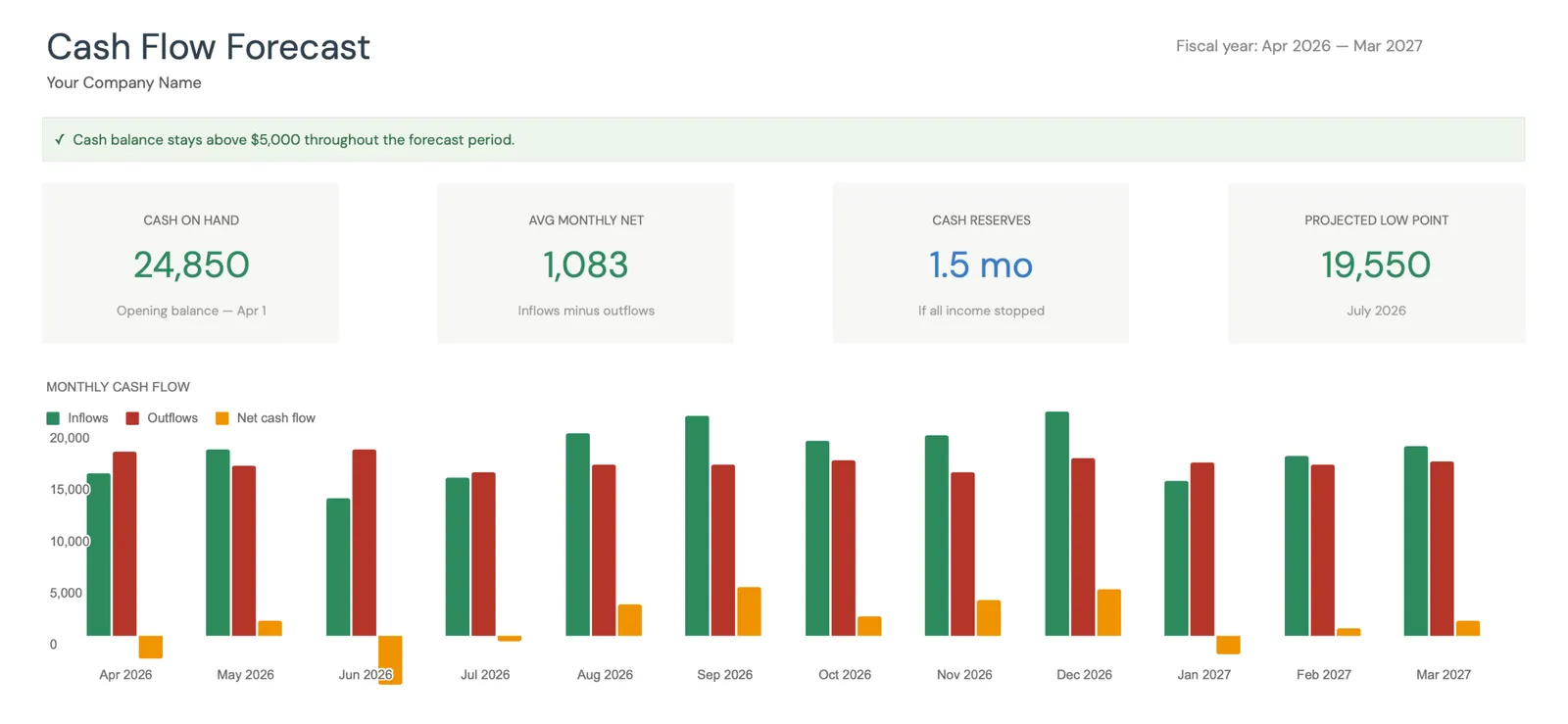
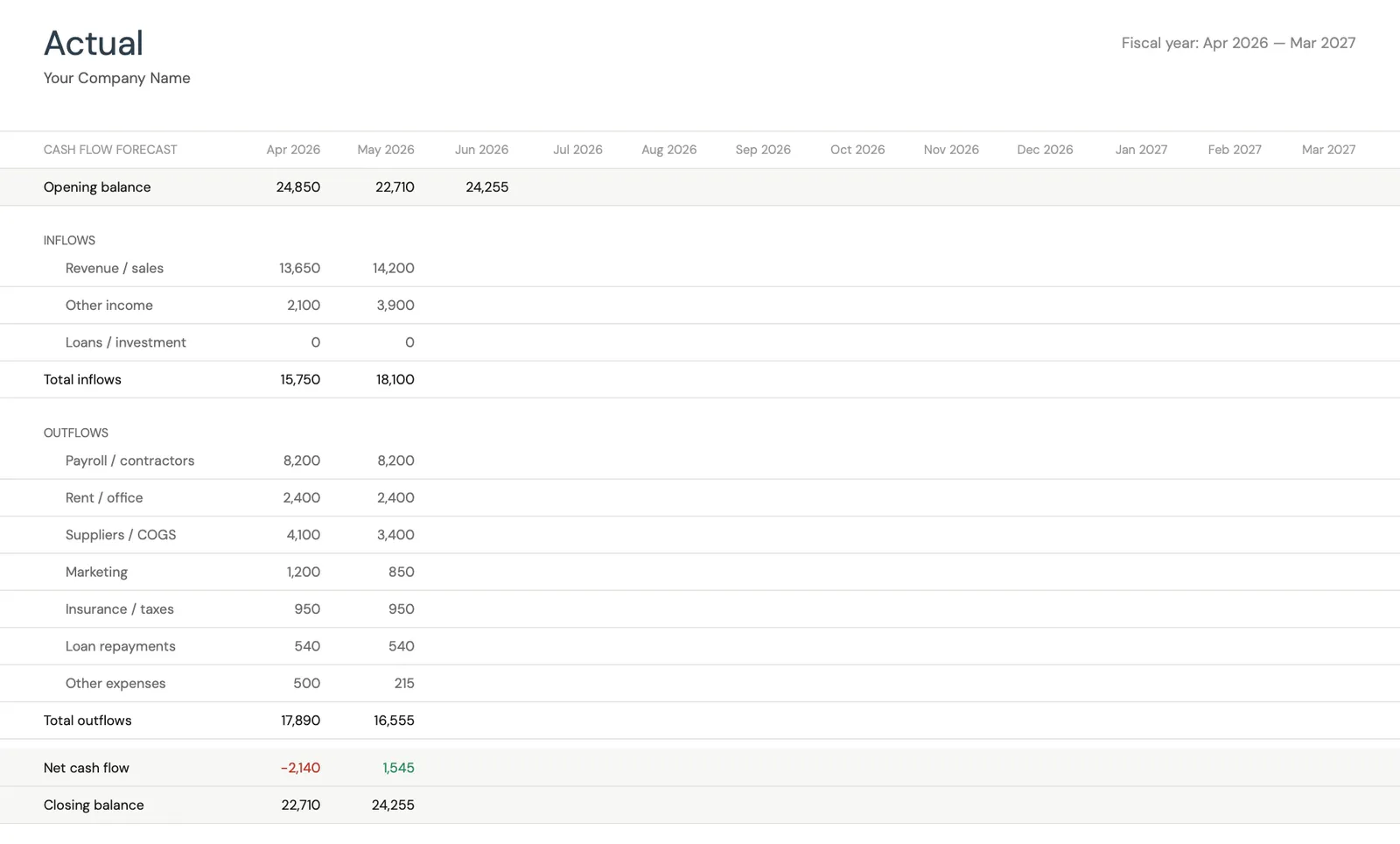
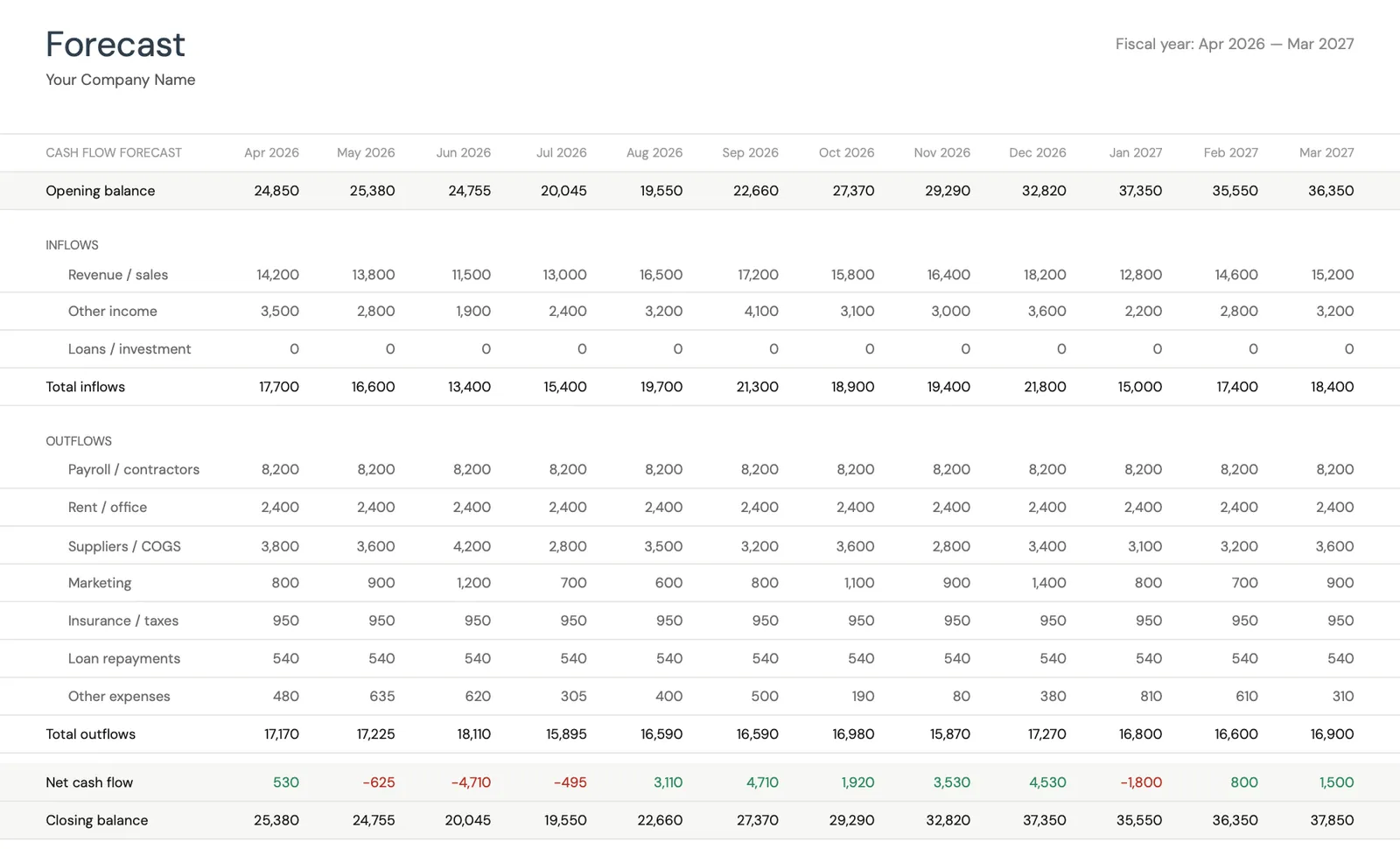
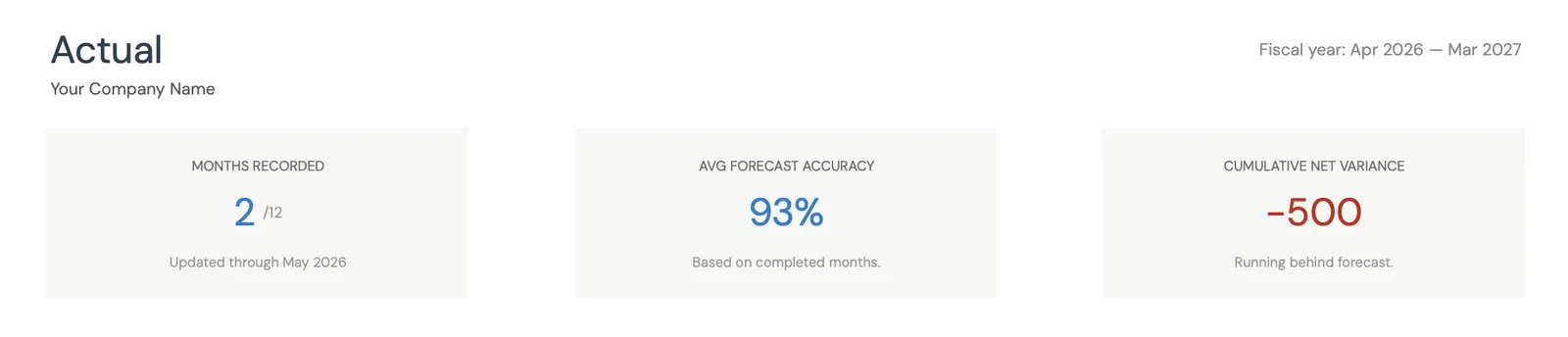
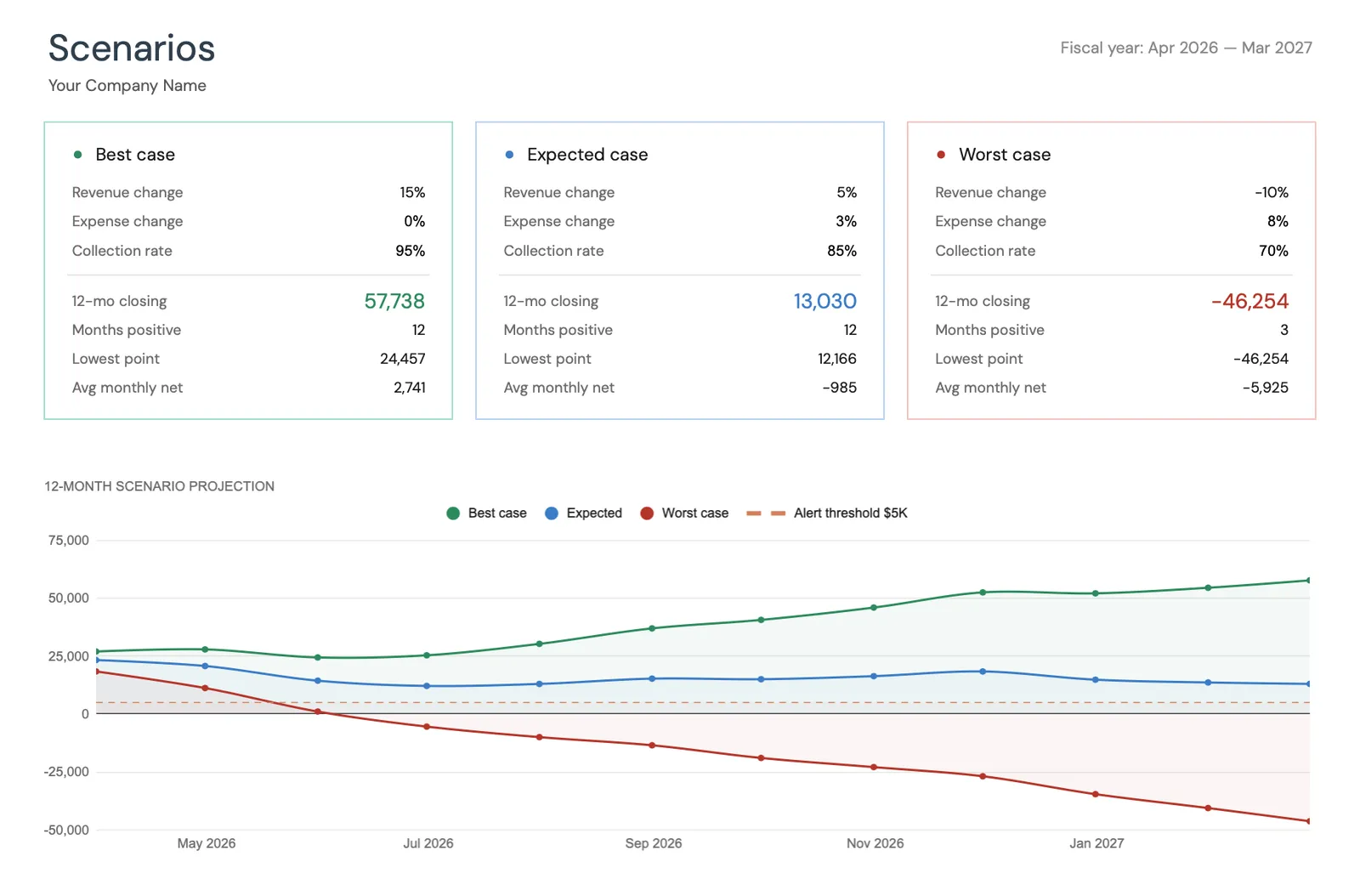
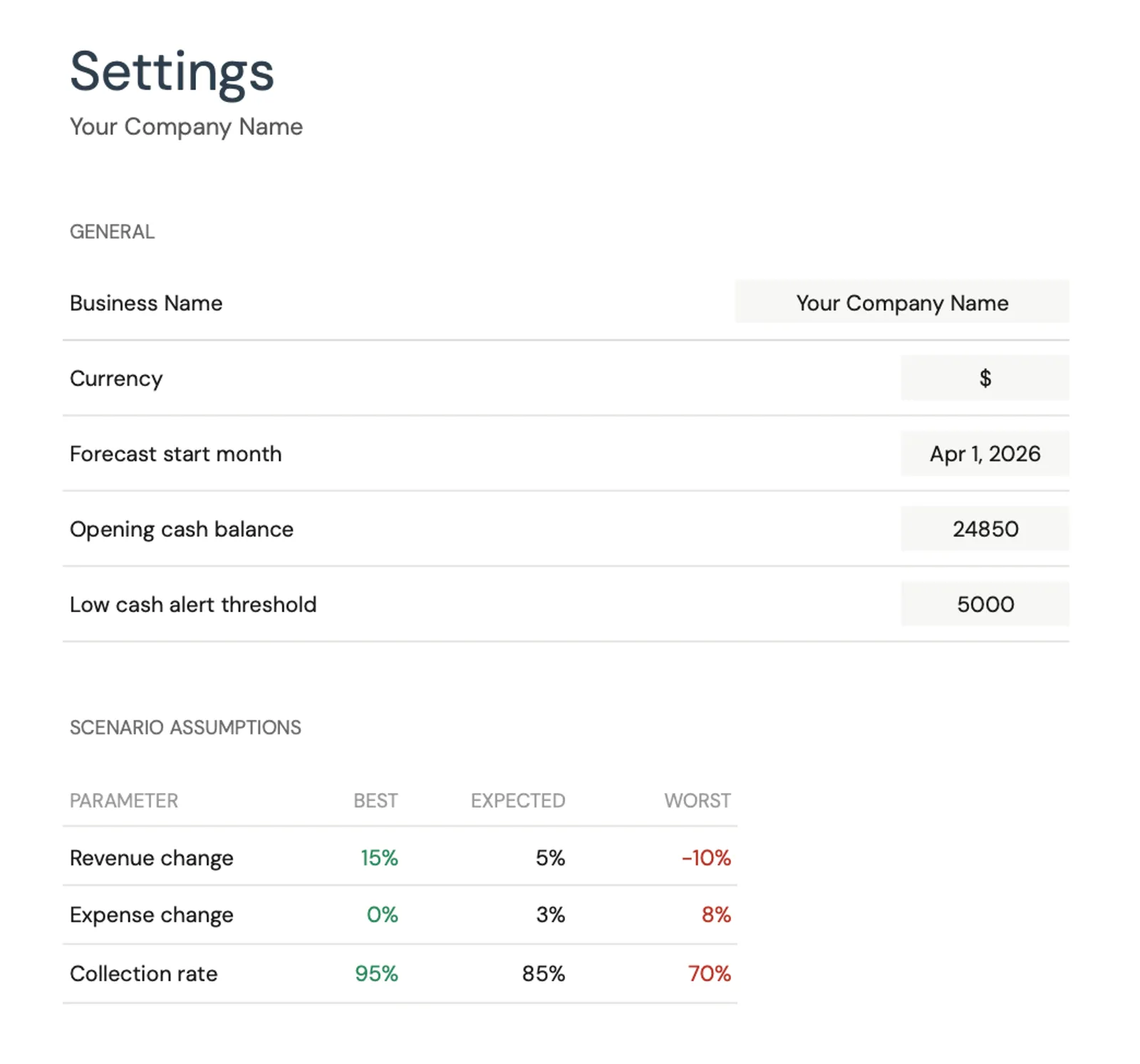
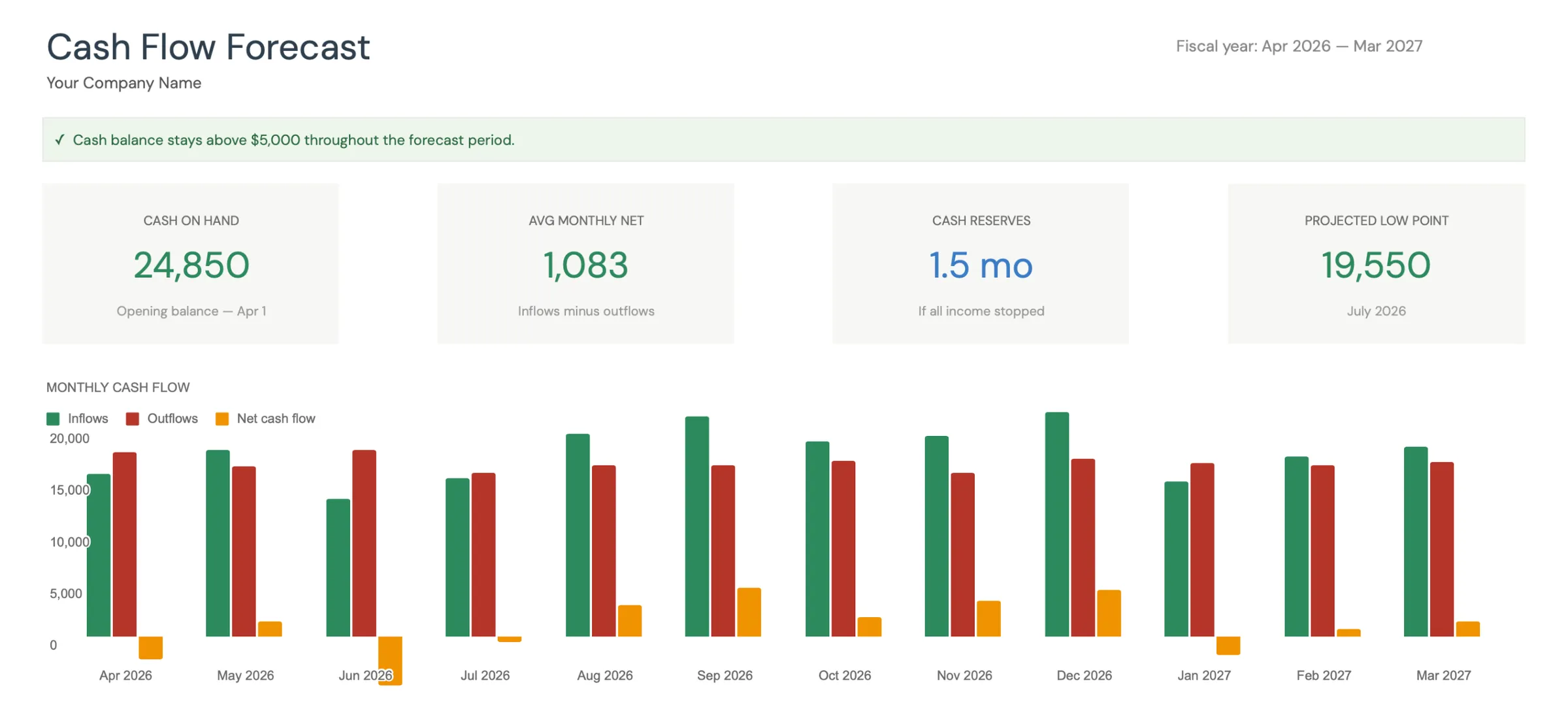
Monthly cash flow overview with KPIs and charts
Track actual cash flow against your forecast
Project cash flow 12 months ahead
Key performance indicators for your cash flow
Model different scenarios for your business
Customize categories for your business type
What You Get
Cash Flow Tools Designed for Accounting and Bookkeeping Firms
Recurring vs seasonal revenue split
Track monthly recurring revenue (bookkeeping, payroll) separately from seasonal revenue (tax prep, year-end work). See how your recurring base covers operating costs during slow months and how much seasonal revenue supplements total income.
Tax season planning
Model the tax season revenue surge against the increased costs (overtime, temp staff, software). The template shows whether peak season profit is sufficient to fund summer and fall operations when revenue dips.
Service line revenue vs billing forecasts
Compare projected revenue by service line against actuals. Track collection timing to build accurate cash forecasts - a $10,000 March billing that consistently collects in May should be forecasted that way.
Tax season to tax season cash outlook
See your projected cash position through the full tax season cycle. Plan for slow-season investments (staff training, technology upgrades, marketing) when cash reserves are at their peak after tax season collections.
Common Questions
Cash Flow for Accounting / Bookkeeping Firms - FAQ
What profit margin is typical for accounting firms?
Net margins for accounting firms typically range from 15-35%, with higher margins for firms with strong recurring revenue and efficient workflows. Solo practitioners often see 40-55% margins (excluding their own salary from expenses). The key metric is revenue per professional staff member - firms targeting $150,000-$250,000+ per staff member generally achieve healthy margins.
How do I smooth out the seasonal revenue cycle?
Build recurring revenue through monthly bookkeeping, payroll services, and advisory retainers. A firm with 60% of revenue from recurring sources has a much smoother cash flow curve than one deriving 80% from tax preparation. The forecast helps model the impact of adding recurring clients - each $1,000/month bookkeeping client adds $12,000/year in non-seasonal revenue.
How much cash reserve do I need for the slow season?
Calculate your average monthly operating costs during the slow season (May-December) and compare against expected monthly revenue for those months. The cumulative deficit is your minimum reserve target. A firm spending $25,000/month with $18,000/month in non-tax revenue needs $7,000/month x 5-6 slow months = $35,000-$42,000 in reserves, funded from the tax season surplus.
Should I hire permanent staff or use seasonal help for tax season?
The forecast helps model both approaches. Permanent staff cost more year-round but provide consistency and the ability to take on more recurring work. Seasonal staff reduce slow-season costs but require annual recruiting and training. Many firms use a core permanent team supplemented by 1-2 seasonal preparers. Model the annual cost of each approach and its impact on capacity and profitability.
How do I handle the transition from hourly billing to value-based pricing?
Value-based pricing (flat monthly fees for bookkeeping, fixed fees for tax returns) makes cash flow more predictable. When forecasting the transition, model new fixed-fee revenue against historical hourly billing for the same clients. The goal is revenue-neutral or better pricing that provides cash flow certainty. The forecast shows the month-by-month impact of converting clients from hourly to fixed-fee arrangements.
Can't find the answer you're looking for? Contact our team
Forecast cash flow for your accounting / bookkeeping firm
One-time purchase. No subscription. Your financial data stays in your Google Drive.