Canada
FIRE Calculator for Canada
Calculate your path to financial independence - factoring in TFSA, RRSP, CPP/OAS, and Canadian tax rules - in a free Google Sheets calculator.
Canada
FIRE in Canada: What to Know
Canadian FIRE planning benefits from universal healthcare, strong government retirement programs, and tax-advantaged accounts - but faces challenges from high housing costs and higher tax rates.
Universal healthcare is a major FIRE advantage
Provincial healthcare covers basic medical needs regardless of employment status. This removes one of the largest FIRE obstacles faced by Americans. Prescription drugs, dental, and vision still require private coverage or out-of-pocket spending, but the baseline is much lower.
TFSA is the ideal FIRE bridge account
TFSA withdrawals are completely tax-free and don't count as income for OAS clawback or other income-tested benefits. For the gap between early retirement and CPP/OAS eligibility, the TFSA is the most tax-efficient source of funds. Maximizing TFSA room each year is a core Canadian FIRE strategy.
CPP and OAS reduce the required portfolio size
A couple both receiving full CPP and OAS could get $40,000-50,000/year combined from government programs alone. This significantly reduces the investment portfolio needed for financial independence, especially after age 65. Some Canadian FIRE planners differentiate between their "early FIRE number" and "post-65 number."
Higher tax rates mean savings rate requires more gross income
Combined federal and provincial tax rates are generally higher than US rates, which means Canadians need to earn more gross income to achieve the same savings rate. However, lower healthcare costs, CPP/OAS benefits, and TFSA tax-free growth partly offset this disadvantage.
Get the FIRE Calculator
Getting Started
How to Use This FIRE Calculator for Canada
Enter your current invested assets
Input total values across TFSA, RRSP, non-registered accounts, and any other investments. Include everything you're counting toward financial independence.
Set your target annual spending
Enter your expected annual expenses in early retirement. With provincial healthcare covered, focus on housing, food, utilities, transportation, insurance, and lifestyle costs. Be realistic based on your current spending.
Add annual savings and investment amounts
Enter your total annual investment contributions across all accounts, including employer RRSP matching. Your savings rate (as a percentage of gross or net income) is the primary driver of your FIRE timeline.
Factor in future CPP and OAS income
Enter projected CPP and OAS amounts and the age you'll receive them. This reduces the long-term portfolio requirement and may allow a smaller FIRE number than the simple 25x calculation.
Review your projected FIRE date
The calculator shows when your investments can sustain your spending. Experiment with higher savings rates or lower spending to see how the date shifts.
See It In Action
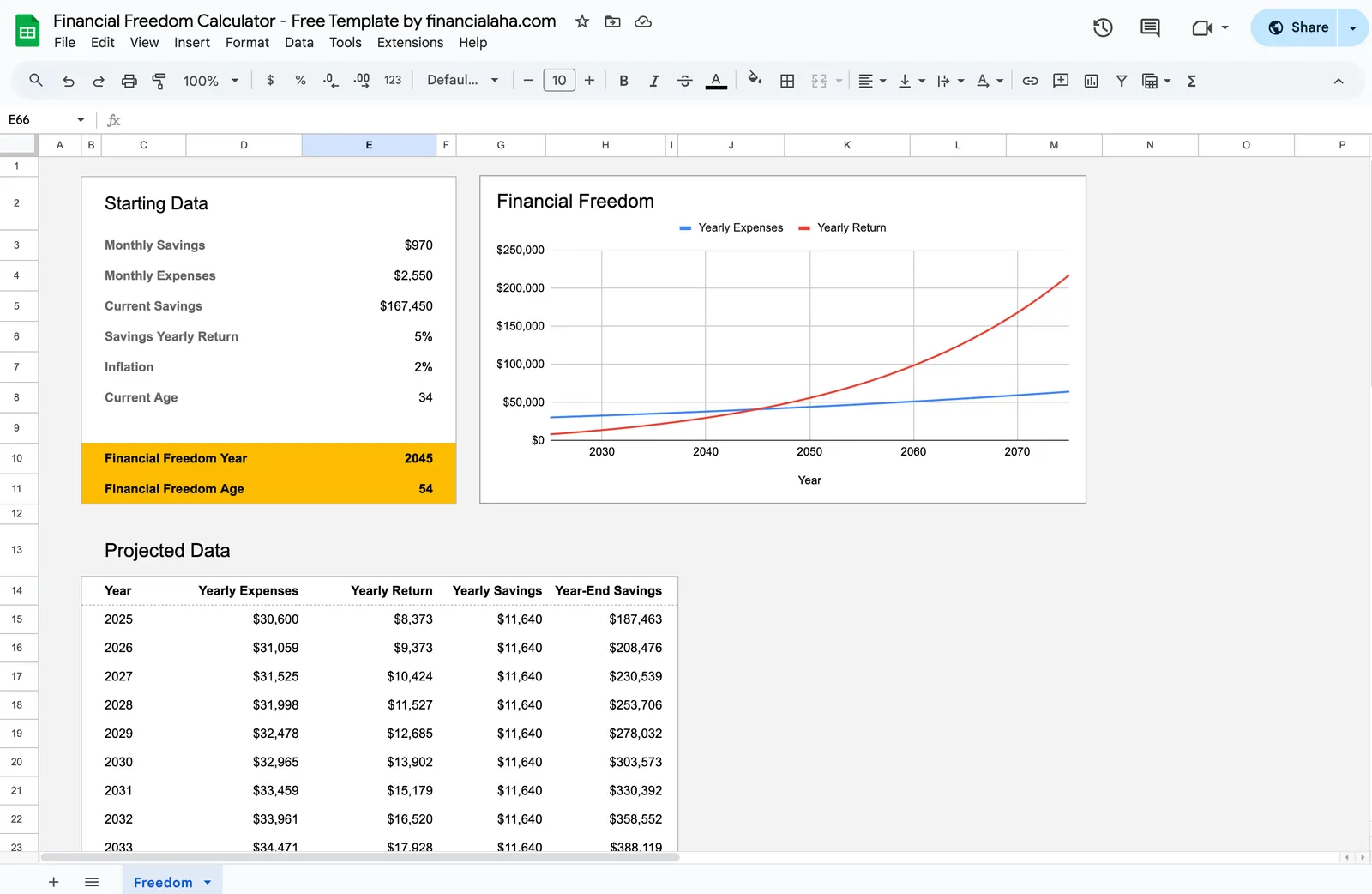
What the template looks like
Browse through the template to see how it handles budgeting, categories, and expense tracking - all adaptable to your local financial setup.
- Built-in currency selector
- Customizable categories
- Budget vs actual tracking
- Visual charts and summaries
Calculate your path to financial independence
Common Questions
FIRE Calculator for Canada - FAQ
Is this FIRE calculator really free?
Yes. The FIRE calculator is completely free - no payment, no email required. It runs in Google Sheets so you own and control your data.
What is a typical Canadian FIRE number?
It depends on spending and location. Someone spending $40,000/year pre-65 might target $1,000,000 (25x expenses). After 65, with CPP and OAS covering $20,000-25,000/year, the portfolio needs to cover less. Housing costs in Vancouver or Toronto drive higher FIRE numbers than in lower-cost cities.
How do I access RRSP money before 65 without huge taxes?
Withdraw gradually to stay in lower tax brackets. In early retirement with low income, RRSP withdrawals are taxed at lower marginal rates. Some people withdraw from RRSP while income is low to convert to TFSA (in effect, a "Roth conversion ladder" Canadian-style). The 10% withholding tax on RRSP withdrawals under $5,000 is just a prepayment - actual tax depends on total annual income.
Does the 4% rule work in Canada?
The 4% rule was based on US market data, but the principle applies globally. Many Canadian FIRE planners use 3.5-4%. With CPP and OAS reducing portfolio dependence after 65, the effective withdrawal rate from personal savings can be higher in the early years, then lower once government benefits begin.
Should I pay off my mortgage before FIRE?
Some people prioritize paying off the mortgage for lower fixed expenses in early retirement. Others prefer investing the money for potentially higher returns. In Canada, mortgage interest isn't tax-deductible (unlike the US), which slightly favors paying it off. The right approach depends on your interest rate, risk tolerance, and comfort level.
Can't find the answer you're looking for? Contact our team
Ready to get started?
Download instantly and start managing your finances, or contact us to design a custom template package for your needs.