
Retirement planning comes down to three numbers: the expenses you will actually have (often 70-80% of pre-retirement income), the income you can count on from every source, and the gap between them. Map each one, then close any shortfall by saving more, shifting your retirement date, or revising expenses.
Most people think about retirement savings as a single number. In practice, retirement planning involves mapping out where money will come from and where it will go - and those two lists look different from working-life finances.
Calculator: The Retirement Calculator estimates how much savings is needed based on expenses, timeline, and expected returns. For a deeper walkthrough of the math, see Retirement Calculator: How Much Do You Actually Need?
How Retirement Expenses Differ from Working-Life Expenses
Some costs decrease in retirement (commuting, work clothes, payroll taxes). Others increase - healthcare, travel, and home maintenance tend to grow. The shift looks roughly like this:
| Category | Working Years | Retirement | Change |
|---|---|---|---|
| Housing | 25-35% of income | 25-35% | Similar (unless mortgage is paid off) |
| Healthcare | 5-10% | 15-25% | Significant increase |
| Transportation | 10-15% | 5-10% | Decrease (no commute) |
| Food | 10-15% | 10-15% | Similar |
| Travel/Leisure | 5-10% | 10-20% | Increase (more time) |
| Taxes | 20-30% | 10-20% | Decrease (lower bracket) |
A common guideline suggests 70-80% of pre-retirement income per year, though that varies widely with lifestyle, location, and whether the mortgage is paid off.
Mapping Income Sources
Retirement income typically comes from multiple streams:
| Source | Typical Range | Notes |
|---|---|---|
| Social Security / Pension | $15,000-$45,000/yr | Depends on earnings history and claiming age |
| 401(k) / IRA withdrawals | Varies | 4% rule suggests $40,000/yr per $1M saved |
| Superannuation (AU) | Varies | Drawdown phase after preservation age |
| Personal savings | Varies | Taxable accounts, CDs, HYSAs |
| Rental income | $5,000-$30,000/yr | After expenses and maintenance |
| Part-time work | $5,000-$25,000/yr | Common in early retirement years |
The more diversified the income, the less exposed any single underperforming source becomes.
As a reference point, the average Social Security benefit for a retired worker was about $1,900 a month in 2025, roughly $23,000 a year, according to the Social Security Administration. The Social Security Calculator takes the benefit figure from your Social Security statement and compares what claiming at 62, 67 or 70 pays. Separately, five common drawdown strategies, including the 4% rule and bucket approaches, cover the different ways retirees turn a portfolio into income.
The Gap Analysis
The core retirement question: does projected income cover projected expenses?
Annual retirement expenses - Annual retirement income = The gapTo put rough numbers to it, the calculator below estimates the savings target implied by your expenses, timeline, and expected return:
If the gap is positive (expenses exceed income), common approaches include:
- Increasing savings rate during working years
- Adjusting retirement age by 1-3 years (significant impact on both savings and drawdown)
- Revising expense expectations
- Optimizing investment allocation for timeline and risk tolerance
The Retirement Financial Planning Spreadsheet takes the first three of those as inputs: annual savings until retirement, target retirement age, and total annual expenses. Allocation is not modeled on its own; it enters as the net return you set for the years before and after retirement. Changing any of them rebuilds the year-by-year projection, and what-if cards on the Summary tab show what a one-year delay, retiring now, or stopping saving today does to the same plan.
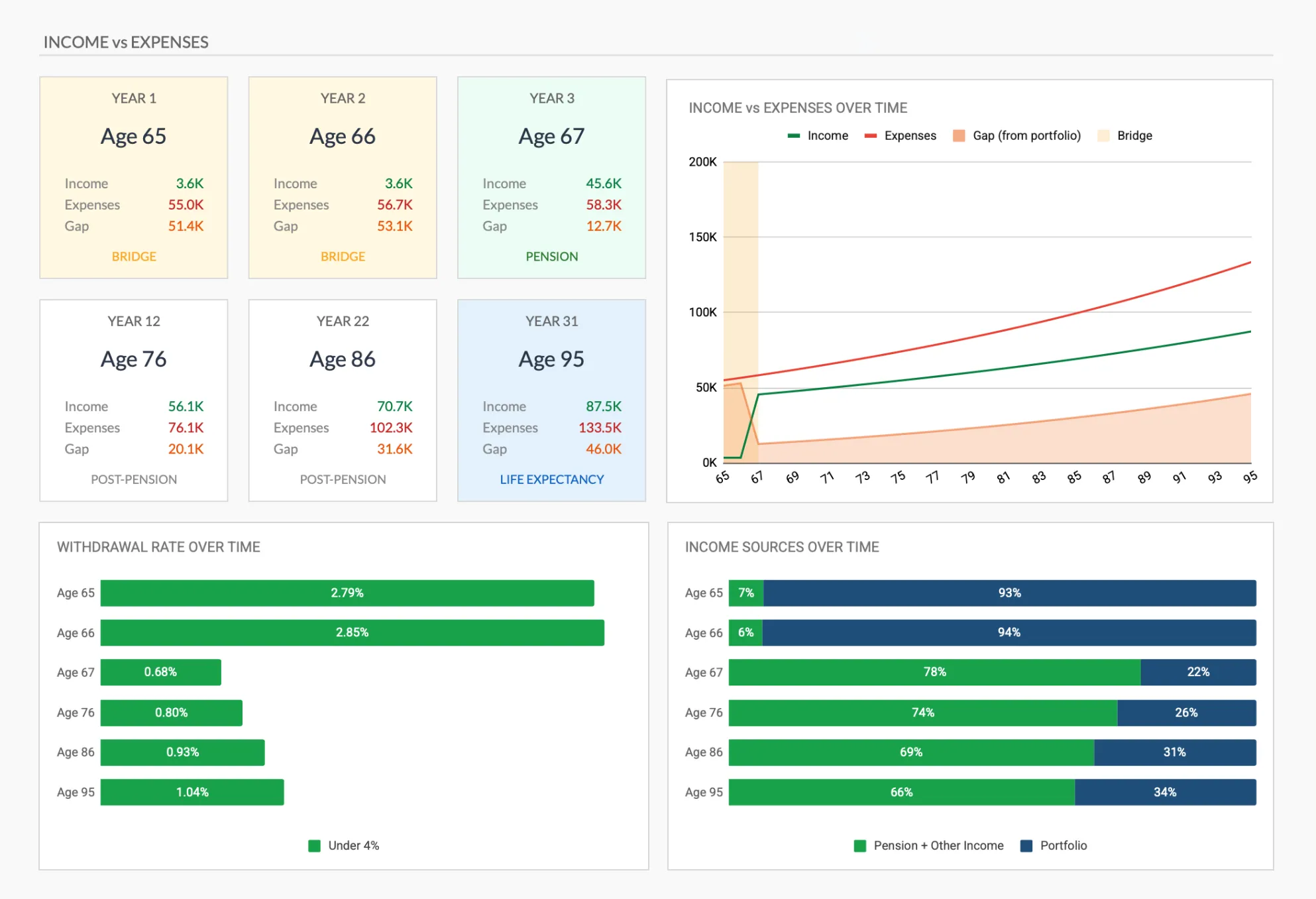 The Income vs Expenses view in the Retirement Financial Planning Spreadsheet (Premium tier) tracks the gap between income and expenses across every year of retirement.
How Often to Revisit the Plan
Annual reviews are generally enough. Key things to assess: investment performance vs projections, any changes in expected expenses, new income opportunities, and whether the target retirement date still feels realistic.
Related
- Retirement Calculator: How Much Do You Actually Need? - The math behind retirement targets
- Retirement Strategies: 4% Rule, Buckets, FIRE, and More - Five approaches compared
- Retirement Financial Planning Spreadsheet - Model scenarios with your numbers
- FIRE Calculator - For those targeting early retirement
- Social Security Calculator - Benefit estimates by claiming age
Frequently asked questions
Does the 4% rule account for taxes and inflation?
In the original study the 4% withdrawal is adjusted for inflation every year, so it holds spending steady in real terms. It does not set aside income tax, though. Withdrawals from a traditional 401(k) or IRA are taxed as ordinary income, so the amount you can actually spend is lower than the headline figure. Modeling the after-tax number is where a projection helps.
Should I include Social Security in the gap analysis?
Most plans do, since it is a lifelong, inflation-adjusted income stream. The amount depends on your earnings history and the age you claim, and claiming earlier permanently reduces the monthly benefit. The Social Security Calculator takes the benefit figure from your statement and shows what claiming at 62, 67 or 70 pays.
How much does retiring a year earlier change the numbers?
Retiring earlier shortens the years you contribute and lengthens the years you draw down, so a single year moves both sides of the gap at once. That is why a small shift in retirement date often has a larger effect than an equal change in savings rate. Running both scenarios side by side shows the trade-off.
Sources
- How Much Do I Need to Retire? - Fidelity
- Determining Withdrawal Rates Using Historical Data (1994) - Journal of Financial Planning
- What Is the Average Monthly Benefit for a Retired Worker? - Social Security Administration
About this article
Replacement-rate and withdrawal figures checked against Fidelity's retirement guidance and William Bengen's 1994 withdrawal-rate study in the Journal of Financial Planning. Social Security averages checked against Social Security Administration figures. Template claims checked on 2026-09-10 against the shipped Retirement Planning Google Sheet (Summary, Inputs, Projections, Helpers, Instructions tabs) and against the Social Security Calculator inputs. Last reviewed September 2026.